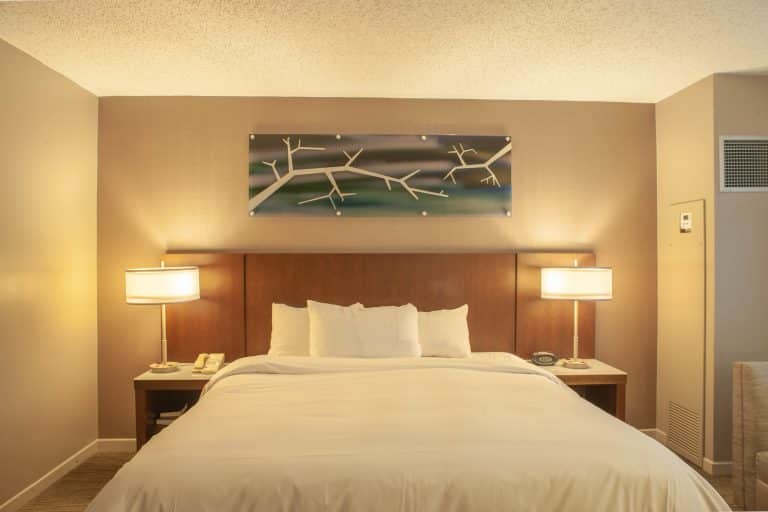
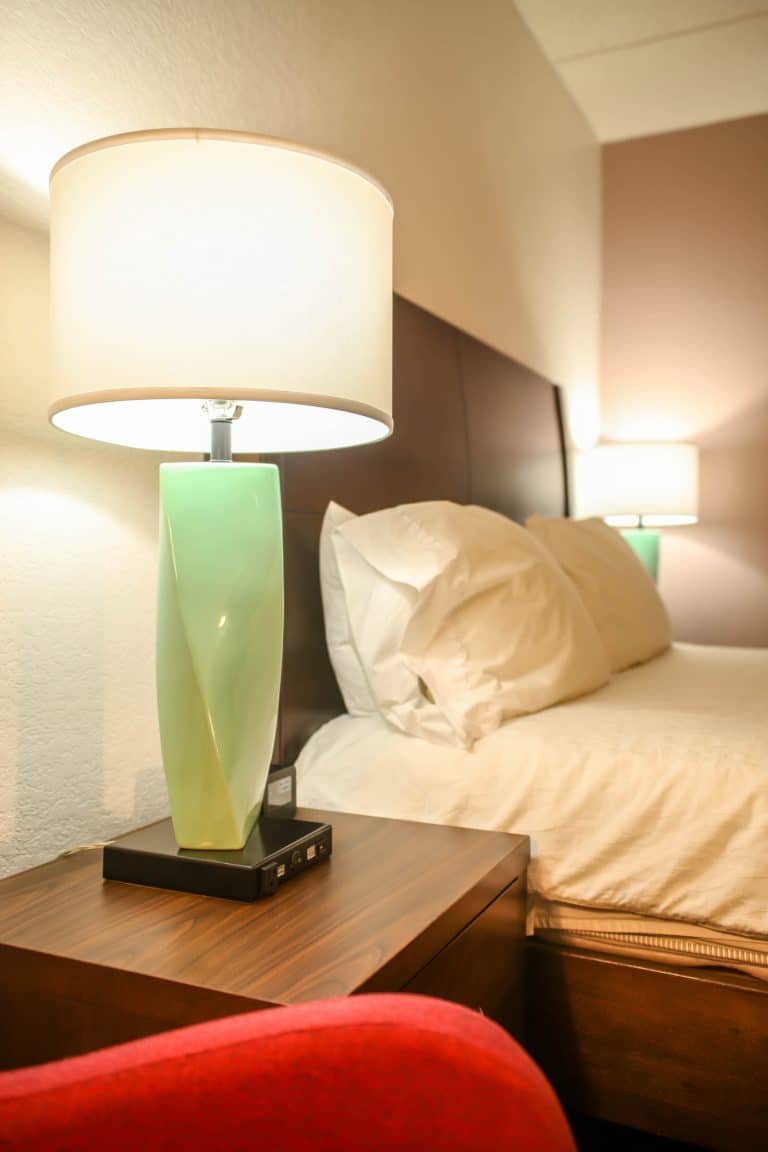
Three fixtures compete for the same job beside a hotel bed: a table lamp, a wall sconce, and a small suspended fixture. All three light a nightstand. They differ in how much surface they consume, how they are wired, and how they behave once a guest starts moving things around.
Small pendant lighting covers suspended fixtures typically under 12 inches in diameter, hung individually or in clusters, used where light needs to land on a defined surface without occupying it. The shade or diffuser sits close to the task, which is what allows a lower-output lamp to do the same work as a larger fixture farther away.
Purchasing agents and brand program managers make this call at scale. A choice that saves four inches of nightstand surface in one room saves it in three hundred. A choice that adds a junction box in the wall adds it in three hundred. The comparison below is the decision, laid out against the criteria that actually change a project.
Small Pendants, Nightstand Sconces, or Table Lamps: Which Fits?
Small pendants win where surface space is scarce and the fixture position must stay fixed. Table lamps win where flexibility and simple replacement matter more. Sconces win where the wall is available and the nightstand is not.
| Criterion | Small pendant | Nightstand wall sconce | Bedside table lamp |
|---|---|---|---|
| Surface consumed | None | None | Significant on compact stands |
| Position stability | Fixed, cannot be moved by a guest | Fixed | Moves constantly, alignment drifts |
| Rough-in required | Ceiling junction box, coordinated early | Wall junction box at headboard | Receptacle only |
| Ceiling height sensitivity | High, drop must be verified per room type | None | None |
| Headboard coordination | Must clear seated sightline | Must clear headboard profile | None |
| Replacement effort | Electrician, room out of service | Electrician, room out of service | Housekeeping level, minutes |
| Damage exposure | Low, out of reach of luggage and carts | Moderate, contact from bedding and guests | Highest, knocked and dragged |
| Best fit | Compact room types, boutique and lifestyle programs | Standard guest rooms with fixed headboards | Rooms where flexibility outranks surface area |
The table is not a ranking. Most properties end up with a mix, and the discipline that matters is deciding which fixture owns which room type before any of them is priced.
When Does a Small Pendant Beat a Table Lamp?
A small pendant is the stronger choice when the nightstand is under roughly 18 inches wide, when the room type repeats at high volume, or when the design intent calls for a clear horizontal surface.
Surface economy is the governing term. On a compact nightstand, a table lamp base can consume 30 to 40 percent of usable surface once the shade footprint is counted. That is the space a guest needs for a phone, a glass, and a charging cable. Removing the base recovers it without removing the light.
Two other conditions push toward pendants. The first is alignment. Table lamps drift out of position between housekeeping visits, so a photographed room and an occupied room stop looking alike. A suspended fixture holds position permanently. The second is damage rate. Table lamps are the most frequently replaced lighting item in a guest room because they are handled daily.
Table lamps remain the better answer when rough-in is not practical, when the property wants housekeeping-level replacement, or when the layout is not standardized enough for a fixed drop point to work in every key.
How Do Small Pendants Stay Consistent Across Guestrooms and Properties?
Consistency in a pendant program is a documentation problem before it is a manufacturing problem. These steps, in this order, are what keep room 214 and the next property’s room 214 looking the same.
- Lock the room types first. Confirm ceiling height, headboard height, and nightstand width for every guest room configuration in the program. A pendant program fails when it is specified against one typical room and applied to five.
- Fix the drop point per room type, not per room. One verified dimension per configuration, recorded in the specification, prevents field decisions during installation.
- Standardize the finish reference. Record the finish against a physical control sample, not a name. Finish names drift between suppliers and years. Control samples do not.
- Document the shade or diffuser completely. Material, dimensions, liner, and fitter type. These are the components most often reordered and most often approximated later.
- Define the substitution rule in advance. Decide which attributes may change if a material becomes unavailable. Diameter and finish usually may not. Internal hardware usually may.
- Log the specification where procurement can find it. A program spanning several years of renovations needs records that outlive the people who created them.
Where Does Small Pendant Lighting Work Outside the Guest Room?
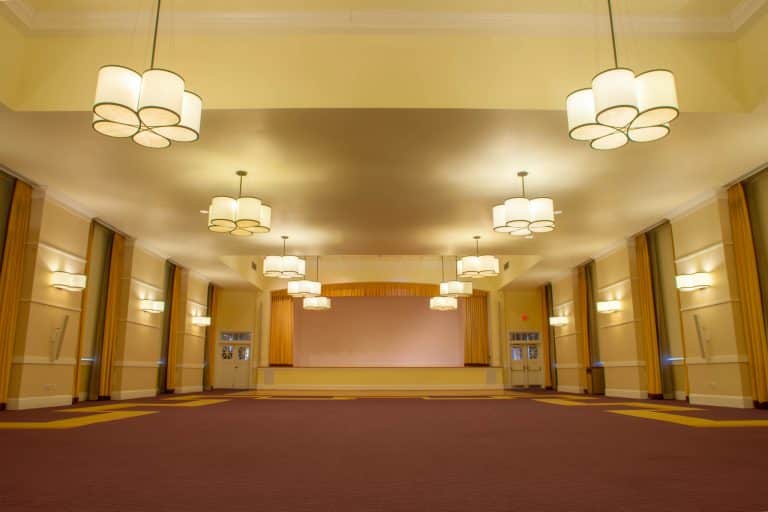
Small pendants scale into public areas through clustering and repetition rather than through size. A row of small fixtures over a long surface reads as rhythm, where one large fixture reads as a centerpiece.
- Bar and coffee counters. Consistent spacing produces even pools across the full counter length without hot spots between drops.
- Reception counters. Small diameters keep sightlines open across the desk, which larger pendants often block.
- Elevator lobbies and landings. A cluster marks the transition from corridor to public area without competing with corridor fixture spacing.
- Banquette and booth seating. One fixture per position defines the zone and keeps output where the table is.
- Market pantry displays. Tight beam control over shelving without the fixture becoming the visual subject.
What Materials Hold Up in High-Use Commercial Environments?
Small fixtures fail in the same places large ones do, but faster, because there is less material carrying the load. Gauge, joinery, and finish quality determine whether a pendant still looks specified in year five.
Metal
Metal holds tight tolerances across repeat production runs, which matters when several hundred fixtures must look identical on delivery. In small diameters the finish does most of the visual work, so finish durability against commercial cleaning agents is the point to confirm.
Acrylic
Acrylic is light and impact resistant, which is useful at lower mounting heights and in rooms where clearance is tight. It diffuses evenly. Cleaning products should be verified against the material before the property standardizes a housekeeping chemical.
Ceramic and wood
Ceramic gives small fixtures visual weight and resists surface wear. Wood pairs with casegoods and warms a room that is otherwise metal-heavy. Both are specified with attention to the finish schedule rather than the raw material alone.
Shades and diffusers
The shade is the component most likely to be replaced during the fixture’s service life. Specifying material, liner, and dimensions at the original order is what allows a replacement years later to match rather than approximate.
Manufacturing Capability and Project Scale
Mario Contract Lighting supports production through a 100,000-square-foot facility in Roanoke, Virginia, and has manufactured lighting since 1922. More than 14,000 projects have been completed since 2000, including work under active brand programs for Hyatt House, Hyatt Place, and Garner.
Domestic fabrication covers metal, ceramic, acrylic, and wood, with shade production and finishing handled in the same facility, so a material substitution can be evaluated against an existing fixture design instead of restarting the specification. Select long-term partner factories are used where a project calls for it, with the manufacturing path selected against material requirements, schedule considerations, and cost targets. Fixture scale runs from components near 3-inch shades up to fixtures around 72 inches in diameter, which allows a small pendant and its large-format counterpart to be produced to one finish standard. Lead times and minimum order quantities are project-dependent and established during quoting.
Practical Questions for Project Teams
What diameter counts as a small pendant?
In hospitality specification, small pendants generally fall under 12 inches in diameter, with bedside and counter applications often between 4 and 8 inches. The functional definition matters more than the number. A pendant is small when it lights a surface without becoming the visual focus of the room.
Do small pendants require a different rough-in than ceiling fixtures?
They require a ceiling junction box at a verified location, which must be coordinated during the electrical rough-in rather than at fixture delivery. The coordination burden is higher than a table lamp and comparable to a wall sconce. Moving a drop point after ceilings are closed is the most common and most expensive field change on a pendant program.
Can small pendants and sconces be used in the same guest room program?
Yes, and mixed programs are common. Properties frequently use pendants in compact room types and sconces in standard rooms, holding one finish standard and one shade language across both. What breaks consistency is mixing fixture families, not mixing fixture types.
How are small pendants handled in rooms with varying ceiling heights?
Adjustable stem or cable systems allow one fixture design to serve multiple ceiling heights while the shade, finish, and light quality stay constant. The drop length is documented per room type so installation does not become a field judgment.
Small Pendants Within a Complete Lighting Plan
A small pendant is not a standalone purchase. It sits inside a room that also contains ceiling fixtures, wall lamps, table lamps, a lighted mirror, and room signage, and a guest reads all of them at once.
The plan that holds up sets the finish standard and shade language first, then assigns each fixture type to the surfaces it suits. Small pendants take the tight surfaces where position must stay fixed. Ceiling fixtures take general coverage. Sconces take headboards and corridors. Table lamps take the rooms where flexibility outranks surface area. Made together, those assignments produce a property that reads as designed. Made fixture by fixture, they produce one that reads as procured.
Explore Pendant Lighting for Hospitality Lighting Projects
Evaluate specification-ready small pendant lighting within a broader hospitality lighting and hotel lighting framework. Solutions are developed to support brand consistency, durability, and project-specific requirements across commercial environments.