Pendants over a lobby desk or a guest room nightstand do more work than their size suggests. They set eye-level brightness, define zones inside open floor plans, and free the surface area that a table lamp would otherwise occupy. Specified poorly, they glare into sightlines, hang out of alignment room to room, and fail early under daily use.
Shade pendant lighting is a suspended fixture whose output is shaped by a fabric, metal, acrylic, or ceramic shade rather than an exposed lamp. The shade controls glare, directs light downward onto a work or gathering surface, and gives the fixture a finished profile that reads as part of the room instead of as equipment.
Purchasing agents, designers, and brand program managers rarely specify one pendant. They specify a family of them across dozens or hundreds of keys, then repeat that family at the next property. The real decision is which pendant scales across space types without the finished building looking assembled from unrelated parts.
Where Does Shade Pendant Lighting Work in a Hotel?
Shade pendants perform best where light needs to land on a defined surface at a controlled height: nightstands, desks, reception counters, lounge groupings, and bar tops. They are a weaker choice for general ambient coverage in low-ceiling corridors, where flush and semi flush fixtures hold up better.
| Space | Typical role | What the shade must do | Coordination point |
|---|---|---|---|
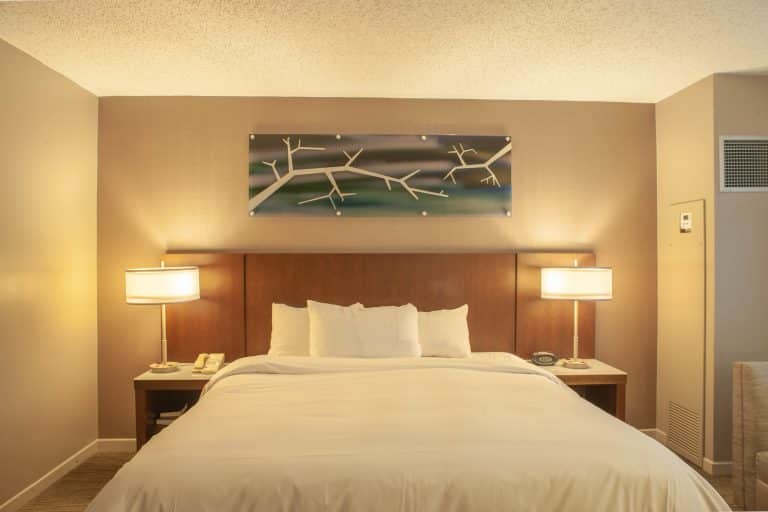
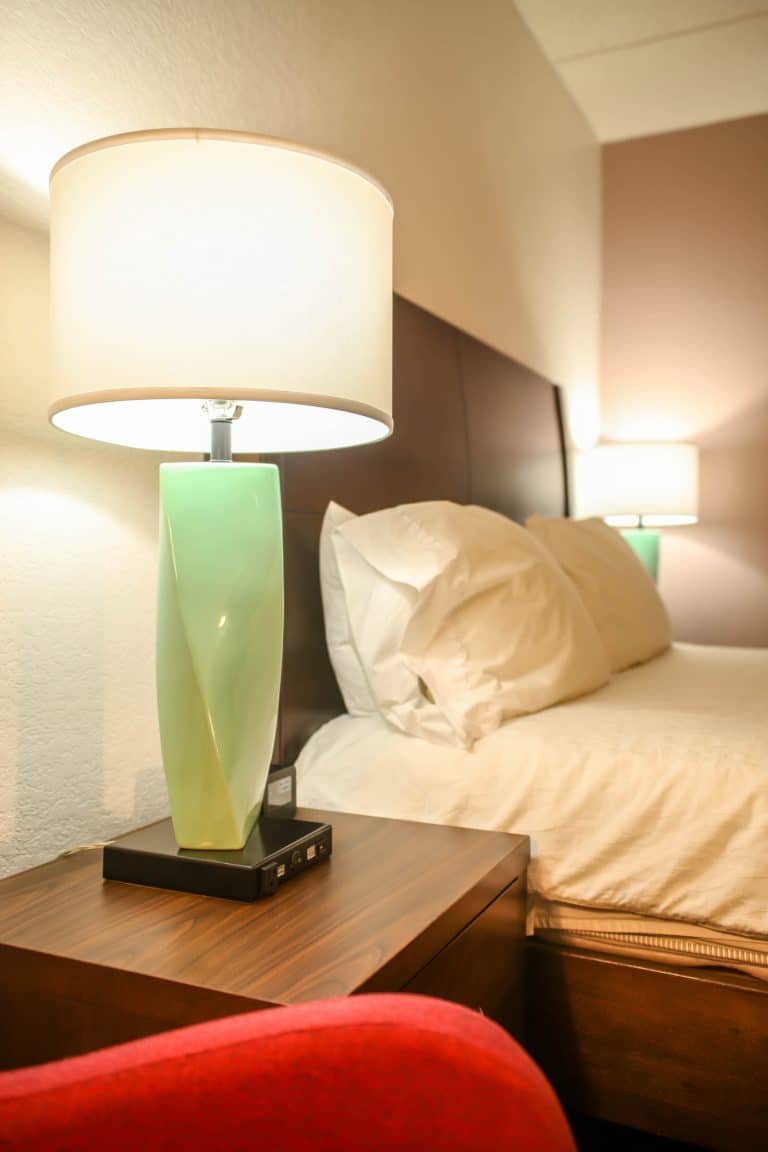
| Guest room nightstand | Replaces or supplements a bedside lamp | Block direct view of the lamp from a reclined position | Headboard sconces, switching, outlet location |
| Guest room desk or work area | Task light over a fixed work surface | Push output down onto the desk, minimize screen glare | Desk lamp, mirror placement, casegoods layout |
| Lobby reception | Marks the arrival point and holds attention | Read cleanly from every approach angle | Ceiling fixtures, signage, daylight from entry glazing |
| Lobby lounge seating | Defines a conversation zone in an open plan | Diffuse evenly at seated eye level | Floor lamps, public area table lamps, upholstery tone |
| Bar and dining counter | Sets rhythm along a long surface | Deliver even pools without hot spots between drops | Counter length, stool spacing, back bar lighting |
How Do Shade Pendants Perform in Guest Rooms?
Guest room pendants succeed when they solve a surface problem the room already has. Nightstands are small, desks are shallow, and every square inch of horizontal surface is contested.
Nightstand and bedside applications
A pendant hung beside the bed clears the nightstand entirely, which matters most in compact room types where the stand is under 18 inches wide. Mounting height is the controlling variable. The bottom of the shade should sit above the sightline of a guest sitting upright against the headboard, so the lamp is never directly visible.
Desk and work areas
Over a desk, a shade pendant provides seated task light without occupying the work surface. Shade opening and interior finish determine whether the light lands as a usable pool or scatters across the wall. A tighter opening with a reflective interior concentrates output where a laptop and paperwork sit.
Reading and glare control
Fabric and acrylic shades diffuse across the full shade surface. Metal and ceramic shades push light down in a narrower cone. Most guest rooms need both behaviors, which is why pendant selection is made against the full room layout rather than fixture by fixture.
Shade Pendants in Lobbies and Public Areas
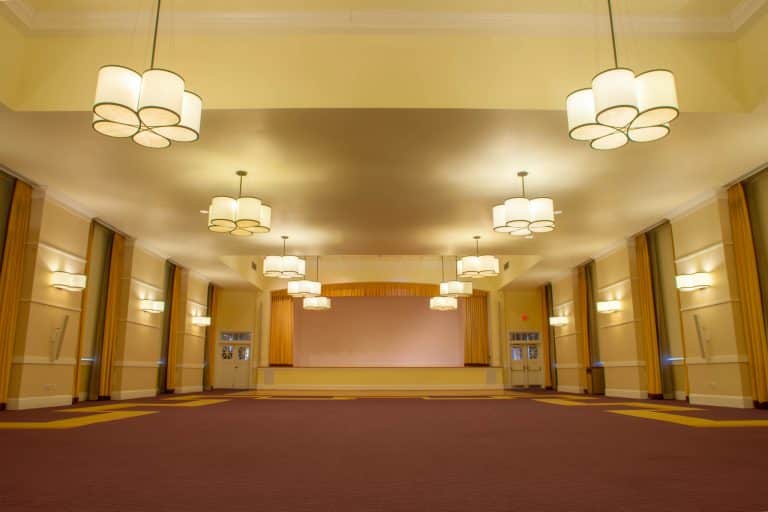
In public areas, pendants carry design weight and take physical abuse from cleaning equipment, luggage carts, and event turnover. Scale and mounting are specified against the room, not against a catalog image.
- Ceiling height drives drop length. A 9-foot lobby and an 18-foot atrium do not share a pendant. Adjustable stem or cable systems keep one design usable across both.
- Cluster spacing controls perceived brightness. Three small pendants at close spacing read differently than one large fixture of the same output.
- Shade diameter is a sightline decision. Fixtures over reception must not block eye contact across the counter.
- Finish must match adjacent metals. Pulls, railings, signage frames, and pendant hardware are read together by a guest standing still.
- Serviceability matters more than in a guest room. Lamp access and cleaning reach determine whether the fixture still looks new in year four.
What Materials Hold Up in High-Use Commercial Environments?
Material selection determines how a pendant ages under commercial cleaning cycles, temperature swings, and constant handling. Contract-grade construction differs from residential product in gauge, joinery, and finish durability.
| Material | Behavior in high-use environments | Strongest applications | Maintenance note |
|---|---|---|---|
| Metal | Resists impact and deformation, holds tight tolerances across repeat runs | Corridors, bars, lobbies, high-turnover public areas | Finish quality determines whether cleaning chemicals dull the surface |
| Ceramic | Heavy, stable, resistant to surface wear, gives visual weight | Lobby feature pendants, reception, restaurant zones | Handling and packaging matter more than in-service durability |
| Acrylic | Light, impact resistant, diffuses evenly, safer at low mounting heights | Guest rooms, bathrooms, spaces with clearance concerns | Cleaning agents must be verified against the material |
| Wood | Warm surface character, pairs with casegoods and millwork | Guest rooms, boutique lobbies, dining areas | Humidity and finish schedule should be reviewed for each property |
| Fabric and hardback shades | Softest diffusion, widest range of profiles and liners | Guest room bedside and desk, lounge seating | Shade replacement is the most common lifecycle item |
Mario Contract Lighting maintains metal, ceramic, acrylic, and wood fabrication along with shade production and finishing inside a single facility, which allows material substitutions to be evaluated against the same fixture design rather than restarting the specification.
How Does Pendant Lighting Stay Consistent Across Guestrooms and Properties?
Consistency comes from documentation, not from reordering the same catalog number. A pendant that looks identical across two properties is usually the result of a controlled finish standard, a fixed set of dimensions, and a shade specification recorded in enough detail to be reproduced years later.
Brand program managers face this at renewal. A property renovated in year one and one renovated in year four should present the same guest experience, but supply conditions between those years will not be identical. The fixtures that survive the gap have locked finish references, defined shade materials and liners, and a documented mounting method. Where a component becomes unavailable, a manufacturer holding the original tooling and finish records can substitute a material without changing what the guest sees.
Property-level variation is still expected. The goal is not identical fixtures everywhere. It is a single visual family that flexes in drop length and diameter while holding finish, shade profile, and light quality constant.
Practical Questions for Project Teams
How high should a shade pendant hang over a nightstand?
The bottom of the shade should clear the sightline of a guest sitting upright in bed, which typically places it above the top of the headboard rather than at nightstand height. Exact drop depends on ceiling height, bed height, and headboard design. Confirm the dimension against the room’s final casegoods drawings, since a change in headboard height moves the pendant.
Can one pendant design be used in both guest rooms and public areas?
Yes, when the design is developed as a family rather than a single fixture. The same shade profile and finish can be manufactured at a small diameter for bedside use and a larger diameter for lobby or bar applications. Drop length, shade size, and lamp specification change while the visual identity stays constant.
Do shade pendants work in corridors?
They work in corridors with adequate ceiling height and no cart or luggage clearance conflict. In standard-height corridors, flush mount and semi flush mount fixtures are usually the better choice, with pendants reserved for elevator lobbies, landings, and widened transition zones where the ceiling opens up.
What determines lead time on a custom pendant?
Lead time depends on material selection, finish requirements, quantity, and whether the fixture is produced domestically or through a long-term partner factory. Lead times and minimum order quantities are project-dependent and established during quoting. They are not fixed values that can be quoted before the specification is defined.
How are shade replacements handled after installation?
Shades are the most frequently replaced pendant component in high-use environments. Recording the shade material, dimensions, liner, and fitter type at the time of the original order allows replacements to be produced to the original specification rather than approximated later.
Manufacturing Capability Behind a Specified Pendant
Mario Contract Lighting supports production through a 100,000-square-foot facility in Roanoke, Virginia, with in-house metal, ceramic, acrylic, and wood fabrication, shade production, and finishing. The company has manufactured lighting since 1922 and has completed more than 14,000 projects since 2000.
Fixture scale runs from small components around 3-inch shades up to fixtures near 72 inches in diameter, which allows a single pendant family to serve a bedside application and a lobby feature without redesign. Select long-term partner factories are used where a project calls for it, with the manufacturing path chosen against material selection, schedule considerations, and cost targets. Lead times and minimum order quantities are project-dependent and established during quoting.
Shade Pendants Within a Complete Lighting Plan
A pendant is one decision inside a room that also contains ceiling fixtures, wall lamps, table lamps, mirrors, and signage. Specifying it in isolation is how properties end up with four finishes on one wall and inconsistent color temperature between the bedside and the bathroom.
The stronger approach fixes the finish standard and shade language first, then assigns fixture types to the surfaces that need them. Shade pendants take the surfaces where light must land precisely and where floor or table space is scarce. Flush and semi flush fixtures take general coverage. Sconces take headboards, corridors, and vanities. Made together, those assignments make the pendant read as part of a plan rather than a flourish added late.
Explore Pendant Lighting for Hospitality Lighting Projects
Evaluate specification-ready shade pendant lighting within a broader hospitality lighting and hotel lighting framework. Solutions are developed to support brand consistency, durability, and project-specific requirements across commercial environments.