Interior Commercial Lighting: What to Check When Comparing Hotel and Residential Lamps
Two lamps can look identical in a showroom and perform very differently after a year in a guest room. One…


Minimum order quantities are a standard part of hospitality lighting discussions. Designers, purchasing agents, and manufacturers all recognize that MOQs influence pricing, production planning, and procurement strategy. The challenge is not whether MOQs are discussed, but when and how clearly they are addressed
When minimum order quantities are understood early and documented accurately, they can be planned around. When they are treated as a secondary detail or assumed to be flexible without confirmation, they often create friction later in the project lifecycle.
This article looks at minimum order quantities as a practical planning variable, focusing on how they influence decision-making across design, procurement, and execution.
Minimum order quantities are driven by manufacturing realities. Tooling setup, material purchasing, labor efficiency, and production sequencing all factor into whether a product can be produced economically at a given volume.
MOQs help manufacturers maintain consistency and quality while managing cost. They are not arbitrary thresholds, but reflections of how fixtures move through fabrication and assembly.
Understanding this context allows project teams to evaluate MOQs as part of an overall strategy rather than as an obstacle.
MOQs affect budgets in more ways than unit price alone. When required quantities exceed actual project needs, teams may need to adjust specifications, consolidate fixture types, or reallocate budget.
In other cases, meeting an MOQ can unlock pricing efficiencies that offset the higher quantity. The financial impact depends on fixture type, level of customization, and production method.
Evaluating MOQs alongside the total scope provides a clearer picture of the true project cost.
Minimum order quantities vary across all hospitality lighting categories.
Recognizing which elements of a lighting package are most sensitive to MOQs helps teams allocate customization more strategically.
Manufacturing strategy plays a significant role in MOQ requirements.
Domestic manufacturing may allow greater flexibility for smaller runs, particularly when customization is controlled and production is closely managed.
Overseas manufacturing often relies on batch production and shipping efficiency, which can drive higher MOQs for fully customized fixtures.
Evaluating MOQs in parallel with the manufacturing approach supports more informed procurement decisions.
MOQs become disruptive when they are finalized after specifications and budgets are locked. Addressing them during specification allows teams to adjust scope before downstream impacts occur.
Early planning strategies may include grouping similar fixtures across room types, standardizing components where appropriate, or deliberately phasing orders.
These decisions are significantly easier to manage early than during procurement or installation.
When understood and documented early, MOQs support better decisions rather than limiting options. They clarify where customization is most efficient and where standardization protects budget and schedule.
For purchasing agents, this clarity improves bid evaluation. For designers, it aligns creative intent with feasibility. For project managers, it reduces procurement risk.
Minimum order quantities are not simply a purchasing requirement. They are planning variables that shape how hospitality lighting programs are structured and executed
To understand how minimum order quantities may affect your hospitality lighting program, work with Mario Contract Lighting early in the specification process to review fixture scope, production approach, and procurement strategy.
Evaluate specification-ready hospitality lighting and hotel lighting. Solutions are developed to support brand consistency, durability, and project-specific requirements across commercial environments.
Recent News & Updates
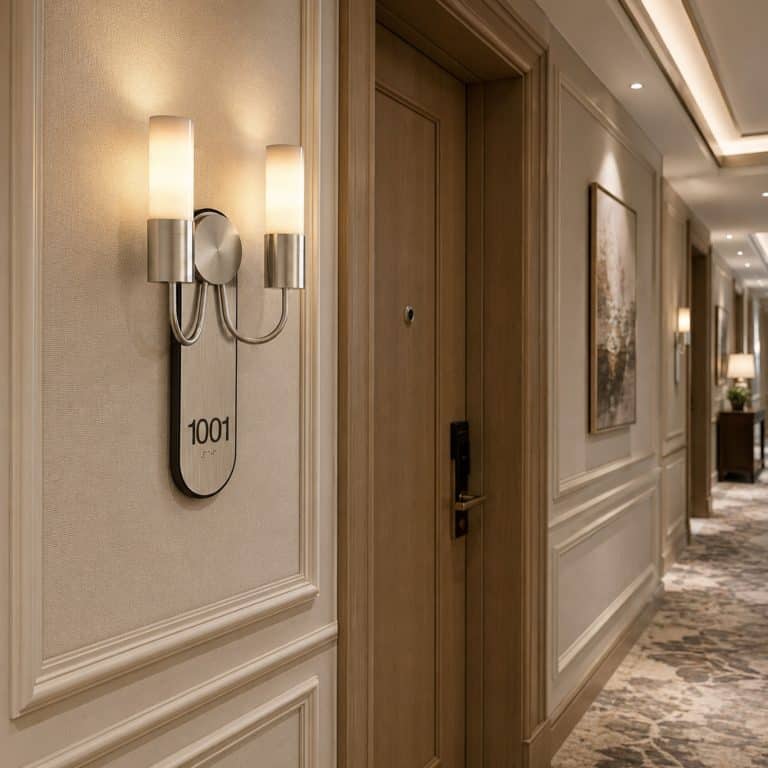
Two lamps can look identical in a showroom and perform very differently after a year in a guest room. One…

Purchasing agents and designers open most guestroom packages with one question: can one lamp carry USB-C charging and a grounded…
A qualified manufacturer can build a light fixture from your sketch or rendering. Custom light fixture fabrication is how a…
Choosing a hospitality lighting manufacturer is one of the first sourcing decisions on a hotel project. The choice shapes your…