This guide explains hotel lighting design for anyone learning it for the first time. It covers the lighting layers and the color and control choices that shape every hotel space.
You will also see how to specify fixtures that survive years of commercial use. As a hotel lighting manufacturer since 1922, we wrote it from the maker’s point of view. We build these fixtures and ship them to properties nationwide.
What Is Hotel Lighting Design?
Hotel lighting design is the practice of planning every light source in a property as one coordinated system. It is organized into layers and zones that match how guests use each space. It treats a bedside lamp and a lobby chandelier as parts of one plan.
Light does two jobs at once. It helps guests see and move safely, and it shapes how a space feels the moment someone walks in.
That feeling starts before check-in is even complete. Per ANSI/IES RP-9-23 (2023), the IES hospitality lighting practice notes that “lighting is often the first feature that guests notice.”
Good design also has to hold up. A fixture in a lobby or corridor runs long hours and gets cleaned often.
The plan has to cover durability and service as much as looks. That maker’s view is why we approach the industries we serve as a specification problem first.
The Four Layers Of Hotel Lighting
Layering means using several light sources with different jobs instead of one bright fixture overhead. Each layer solves a different problem, and together they give a space depth and flexibility.
A single overhead light flattens a room and creates harsh shadows. Layers let you raise or lower one part without touching the rest. That is how a room shifts from bright and busy to calm and warm.
Here are the four layers and what each one does.
| Layer | Purpose | Typical Fixtures |
|---|---|---|
| Ambient | General, even light so people can see and move safely | Recessed downlights and ceiling fixtures for hotels |
| Task | Focused light for a specific activity like reading or working | Bedside lamps and vanity lights |
| Accent | Draws the eye to art and architecture | Track heads and picture lights |
| Decorative | The fixture itself is a design feature and focal point | Chandeliers and statement pendants |
Most well-designed hotel spaces use all four layers. The mix changes by room, but the principle stays the same across the property.
Hotel Lighting Room By Space
Every space in a hotel asks light to do something different. A lobby wants to impress and guide, while a guest room wants to relax and support rest. The sections below follow a guest through the property, so each space builds on the last.
Lobbies And Arrival
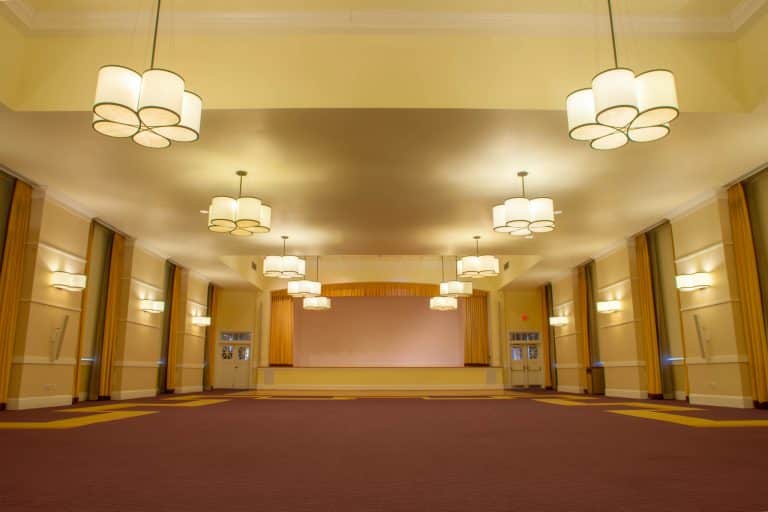
The lobby is where the four layers make their first impression, so decorative fixtures often lead here. A large pendant or chandelier signals the brand and gives the eye a focal point.
Behind that statement piece, warm ambient light makes arrival feel welcoming. Accent light on art and architecture adds depth and quietly guides guests toward the front desk and the elevators.
Guest Rooms
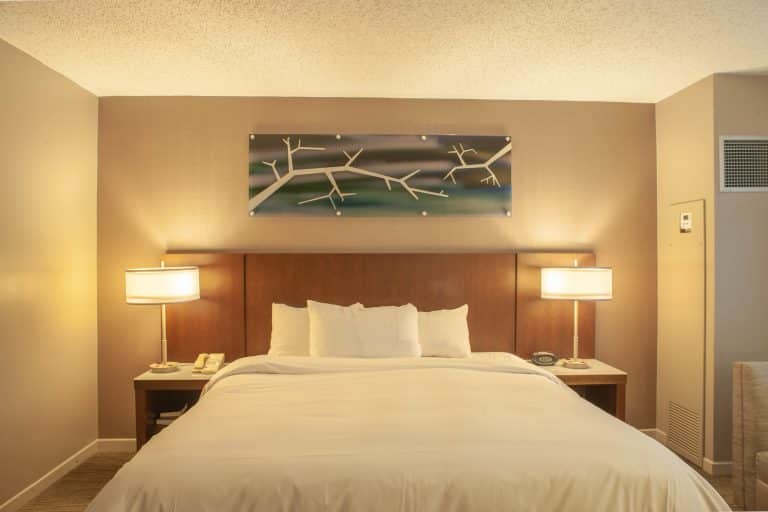
After the lobby welcomes a guest, the room has to help them settle in, so it needs the most careful layering of any space. The goal is adjustable light that each guest can control for reading at night or working during the day.
Here the lighting should support the guest and then step back. We break the guest room into five zones in the next section, since that model makes specification much clearer.
Bathrooms And Vanities
The bathroom is the one guest-room zone where accuracy matters more than mood. Its lighting has one demanding job: showing skin tone accurately at the mirror. Light that renders color poorly makes guests look washed out, which reads as low quality.
The fix is even, shadow-free light at the face, usually from sources beside or around the mirror. This matters most where guests apply makeup or shave, so color quality here is a priority to get right.
Restaurants And Bars
Public dining spaces flip the bathroom’s priority back toward mood. They use lower ambient levels to create a relaxed, intimate feel. The contrast between a dim room and brighter pools of light is what makes a table feel private.
Focused task light on each table keeps food looking appealing and menus readable. Warm tones support the mood and flatter both the food and the guests.
Corridors
Between all these rooms, corridors carry guests from one space to the next, yet they get overlooked. The priority is consistent color temperature so a hallway does not clash with the rooms on either side of it.
Corridors also handle wayfinding, helping guests orient themselves and find their rooms. Wall sconces work well here because they add task and ambient light without eating into tight ceiling space.
The Five Lighting Zones Of A Guest Room
A guest room is small, but guests use it in many ways. Breaking it into five zones helps you place and switch each light where it is actually needed.
The table below lists each zone and the main lighting job to get right there.
| Zone | Lighting Task | Key Consideration |
|---|---|---|
| Entry and closet | Safe, immediate light on arrival | Simple switching guests find without hunting |
| Bed and headboard | Reading light for each side | Independent switches so one guest does not disturb the other |
| Desk and workspace | Focused light for laptops and paperwork | Enough brightness with low glare on screens |
| Seating and reading | A second pool of light away from the bed | Adjustable direction and height |
| Bathroom and vanity | Even, accurate light at the mirror | High color accuracy on the face |
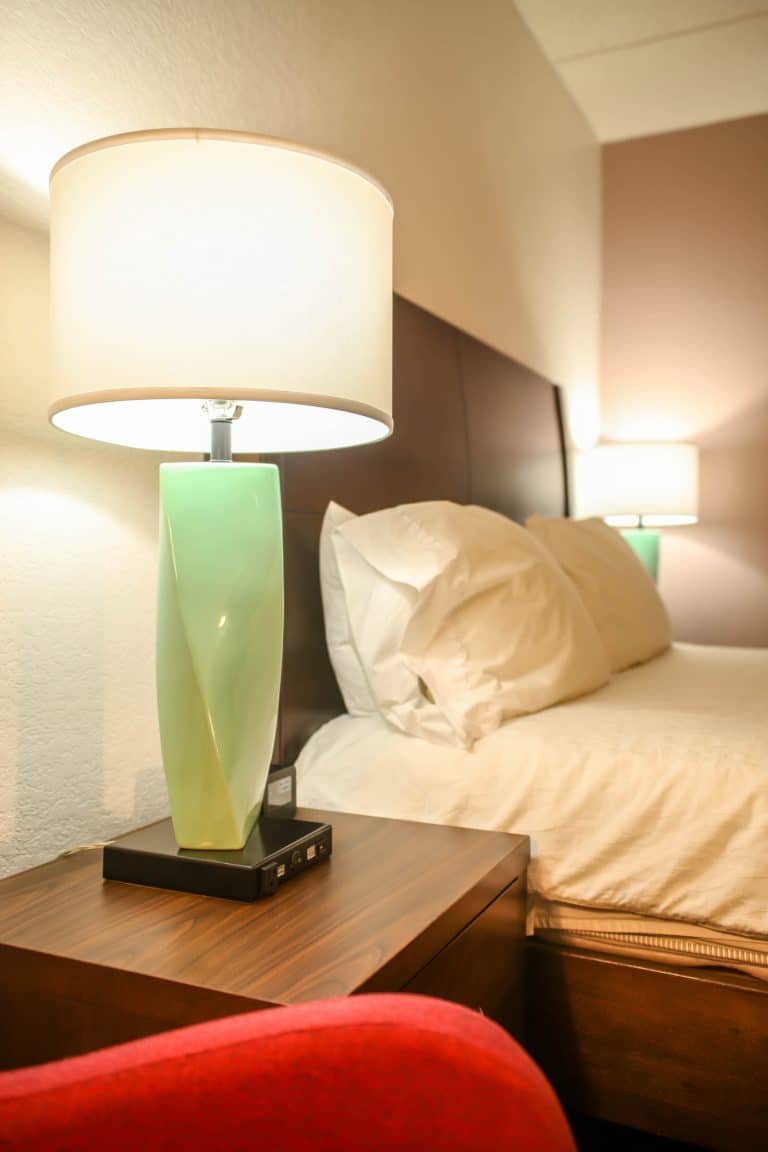
Two fixtures do a lot of the work here. Contract-grade table lamps give each side of the bed its own reading light.
A reading light in the seating zone creates a second place to sit and relax away from the bed. Hospitality floor lamps fill that role well. Specifying each source on its own switch is what makes the room feel personal.
A Project Example: The Darcy, Washington, DC
A finished project shows how those zones get built. At The Darcy in Washington, DC, the scope covered guestroom and corridor lighting across four fixture types: ceiling fixtures, floor lamps, table lamps, and wall lamps.
The materials carried the design intent. The crystal table lamps were made from clear resin for a sleek, transparent look, and the floor lamps pair acrylic with wood.
That is a normal shape for a guest-room package. The zones stay the same from property to property, while the material and finish choices are what make one room look like The Darcy and not like the hotel next door. The project was purchased through Beyer Brown, with interior design by Beleco Design.
Choosing Color Temperature And CRI
Color choices are a core part of hotel lighting design. Two numbers shape how light looks: color temperature and CRI. Both are easy to understand once you see what they measure.
Color temperature is measured in Kelvin (K) and describes whether light looks warm or cool. Lower numbers look warm and golden, while higher numbers look cool and blue-white.
For guest rooms, warm light around 2700K–3000K is standard design practice because it feels calm and residential. Keeping the color temperature consistent across a single room also prevents a patchy, mismatched look.
CRI, or Color Rendering Index, measures how accurately a light shows the true color of objects, on a scale up to 100. The DOE color rendering guidance says a CRI in the “70s would be considered acceptable for interior applications,” with the 80s “good” and 90s “excellent.”
That is why bathrooms often call for higher CRI, commonly 90 and above. Accurate color at the mirror is what makes skin tone look natural to the guest.
Lighting Controls, Dimming, And Smart Systems
Controls are where hotel lighting design meets daily operations. Good controls let guests set the mood they want without reading a manual.
The base is independent switching, so each zone turns on and off by itself. Dimmable circuits then let guests soften the light. Scene presets or DALI systems can group several fixtures into one-touch settings like “Welcome” or “Night.”
A guest panel only works if it is obvious. A confusing switch bank frustrates guests, so intuitive layout matters as much as the technology behind it.
Controls also carry an energy-code role. Where ASHRAE 90.1-2022 has been adopted, the ASHRAE 90.1-2022 lighting changes require guest-room lighting to shut off “after 20 minutes of the space becoming unoccupied.”
That rule ties controls directly to compliance for owners and operators. It also connects to service, since fixtures on well-planned circuits are easier to isolate and maintain.
LED Lighting For Hotels: Efficiency And Durability
LED is now the standard light source for hotels, and the reasons are practical. LEDs use less energy and last far longer than older bulbs. They also give off less heat, which matters in a building that runs around the clock.
Lighting is one controllable load in a commercial building. Per EIA commercial lighting data, it was “about 17% (208 billion kWh) of electricity consumption by U.S. commercial buildings” in 2018.
The efficiency gain is real. Per DOE LED energy savings, ENERGY STAR rated LEDs “use at least 75% less energy, and last up to 25 times longer, than incandescent lighting.” That comparison is against incandescent lamps, and it reflects how LED technology performs against them broadly.
Long life is what makes LED valuable in high-traffic hotels, where relamping a fixture takes staff time. The DOE LED lifespan data puts the useful life of good white LED products at “30,000 to 50,000 hours or even longer.” The same DOE figures put a typical incandescent lamp at about 1,000 hours.
Durability also goes beyond the LED itself. The shade and finish both have to survive repeated cleaning, which is where contract-grade construction earns its place.
Specifying For Durability And Multi-Property Consistency
For specifiers, the hard part starts after the design looks good. Contract-grade construction and serviceable parts keep a fixture working for years. Finishes that hold up under commercial cleaning keep it looking new.
Real projects also run on numbers that shape the whole rollout. Minimum order quantities and lead times have to line up with the install schedule. Brand-standard consistency across many properties matters just as much.
Customization is central to solving that. You can adjust a fixture’s finish options and size to fit the space. Mounting can change too, or the fixture can be built as a fully original design through a custom lighting request.
Scoping energy correctly helps set expectations too. Per EIA lodging energy data, lighting and several other loads “each accounted for 10% or less of end-use energy consumption” in hotels.
That data keeps the conversation honest: lighting is a meaningful load to control, though other end uses consume more energy. We have completed more than 14,000 projects since 2000 from a 100,000-square-foot facility in Roanoke, Virginia. We are also an approved vendor for brands including Hilton and Marriott, which keeps a rollout consistent from one property to the next.
Common Hotel Lighting Design Mistakes To Avoid
A few mistakes show up again and again in hotel lighting design. Spotting them early saves rework and guest complaints.
Flat, cool-white light everywhere is the most common error. It makes guest rooms feel clinical instead of restful, especially when the color temperature jumps between fixtures in the same room.
Poorly placed bedside lamps are another frequent problem. A lamp set too far from the headboard forces the guest to get up to switch it off. Good placement and independent switches fix that.
Low-CRI bathrooms and rooms with no independent zones both frustrate guests in quiet ways. So does relying on one ceiling fixture to do every job, which flattens the room and removes any way to adjust the mood.
This also explains a common question: why do many guest rooms not have a central ceiling light? Designers often choose lamps and sconces on purpose, because layered, switchable sources feel residential and give guests real control.
The last mistake is specifying lighting only after the interior design is locked. That leaves no room to place circuits and fixtures well.
Frequently Asked Questions
What are the four types of lighting used in hotels? The four types are ambient, task, accent, and decorative lighting, and most well-designed spaces use all four together. Ambient covers general visibility while the other three handle specific jobs.
What color temperature is best for hotel lighting? Warm light around 2700K–3000K is standard design practice for guest rooms because it feels calm and residential. Keeping the color temperature consistent within a room matters just as much as the number itself.
Should hotel rooms have dimmable lighting? Yes, dimmable lighting lets guests set the right brightness for reading or relaxing. Pairing it with independent zone switches gives guests the most control.
Why don’t hotels have ceiling lights in guest rooms? Many designers skip a central ceiling fixture on purpose and use lamps and sconces, because those feel residential and let guests control each area. A single overhead light tends to flatten the room and remove that flexibility.
What is the best lighting for a hotel bathroom mirror? The best mirror lighting is even and shadow-free at the face, usually from sources beside or around the mirror. A CRI of 90 or above keeps skin tone looking natural.
What is the 5’7″ lighting rule? There is no recognized industry standard called the “5’7″ lighting rule,” so it is best treated with caution rather than as a fixed number. What specifiers actually rely on is layered, independently controlled light placed by how guests use each zone.
Conclusion
Great hotel lighting design works in layers, tuned to each zone. It stays easy to control and holds up under years of commercial use. When those pieces work together, a property feels welcoming in the lobby and restful in the room.
Turning that design intent into real fixtures is a manufacturing problem, and that is our work. We are a custom, contract-grade manufacturer serving hospitality since 1922. We help the designers and purchasing agents who plan each rollout hold their brand standards steady.
Explore our Custom Capabilities or schedule a consultation today.