Interior Commercial Lighting: What to Check When Comparing Hotel and Residential Lamps
Two lamps can look identical in a showroom and perform very differently after a year in a guest room. One…


Hotel lighting control is the combination of switches, dimmers, sensors, and drivers that decides when a fixture turns on, how bright it goes, and who is allowed to change it. It covers three separate layers: the device a guest or staff member touches, the signal that travels from that device, and the fixture hardware that has to respond.
Most specification problems happen at the third layer. A control system only performs as well as the fixtures wired to it.
A lamp whose driver doesn’t match the control will flicker, drop out at low levels, or refuse to dim past 20 percent no matter how good the dimmer is. That failure shows up on the punch list, not in the control drawings.
This guide covers the fixture half of the problem: the part that lands on a lighting schedule rather than an electrical one. It is written for the designers, purchasing agents, and project managers who specify hospitality lighting solutions on a deadline.
Energy is the short answer. According to ENERGY STAR, lighting accounts for close to a quarter of the electricity a typical hotel uses, before counting its knock-on effect on cooling load.
Code has caught up to that number. ASHRAE/IES Standard 90.1-2022 requires all lighting and switched receptacles in hotel and motel guest rooms and suites to turn off automatically within 20 minutes of the room becoming unoccupied, and it removed the previous exception for key card controls.
Two things follow from that for anyone building a fixture schedule:
Guest bathrooms have a separate rule. According to Leviton’s ASHRAE 90.1-2022 design guide, bathrooms need their own control that turns the bathroom lighting off automatically within 30 minutes after occupants leave, with up to 5 W of night lighting exempt.
Which edition of 90.1 applies depends on what your jurisdiction has adopted, and adoption lags publication by years in most states. The locally adopted code determines what applies, so confirm the version with the authority having jurisdiction before locking a control strategy.
Four methods cover nearly every hotel project. Each one asks something different of the fixture.
Line-voltage switching is simple on and off. Forward phase-cut dimming, often called TRIAC or leading-edge dimming, chops part of the AC waveform to reduce output, and works over the same two wires an existing switch already uses. 0-10V dimming sends a separate low-voltage signal on its own pair of conductors. Digital and networked control, including DALI and wireless mesh systems, addresses each fixture individually and supports scenes, scheduling, and reporting.
| Method | How it dims | Typical use | What the fixture needs | Main trade-off |
|---|---|---|---|---|
| Line-voltage switching | No dimming | Corridors, back of house | Standard driver | No level control at all |
| Phase-cut (TRIAC) | Cuts the AC waveform | Guest room retrofits | Phase-dimmable driver, verified compatibility | Flicker and poor low-end if mismatched |
| 0-10V | Separate low-voltage signal | New construction, public areas | 0-10V driver, two extra conductors | Needs wiring most retrofits don’t have |
| Digital / networked | Addressed digital signal | Full-property systems | Driver with digital interface | Highest cost and commissioning effort |
No method is universally smoother or better. Dimming performance depends on how well the dimmer, driver, light source, and control system work together, and any of the four can perform poorly when those parts aren’t matched.
Phase-cut deserves particular attention to compatibility, because the dimmer and the driver have to agree without any digital handshake. NEMA SSL 7A exists for exactly this reason: the standard was written so that dimmers and LED light engines tested against its criteria will work together without every individual pairing needing its own test.
Networked control carries the strongest energy case. A 2020 DLC and NEEA study found that adding networked controls to LED projects produced additional savings averaging 49 percent across building categories, approaching 70 percent for some building types.
That study looked at commercial buildings broadly, and hotel guest rooms were not one of its named categories. Treat the figure as a signal of range, not a number to put in a guest room payback model.
Control drawings specify the system. The fixture schedule specifies whether it works.
Three details on the schedule decide most of it: where the switch sits, what the driver can do, and whether the fixture is hardwired or plugged in.
In a guest room, most control happens at the bed. The switch on a night stand lamp or a wall fixture beside it is the control interface a guest uses more than any panel on the wall.
Reach matters more than style here. A switch a guest has to sit up and hunt for gets used once and then ignored.
Headboard wall lamps solve this by putting reading light and its switch within arm’s length on each side. Where two guests share a room, each side needs independent control. One switch for both reading lights is a complaint waiting to happen.
Specify the switch type explicitly: rocker, toggle, touch dimmer, or none. “Switched” on a cut sheet does not tell a factory which one to build.
The driver inside the fixture sets the dimming range the fixture can reach, but the result in the room depends on the whole chain: dimmer, driver, light source, and control system.
Write the protocol on the schedule rather than the word “dimmable.” A fixture marked dimmable with no protocol named is a phase-cut assumption waiting to meet a 0-10V circuit.
Name the minimum dim level too. A driver that bottoms out at 10 percent and one that reaches 1 percent produce very different rooms at night, and the difference between them is invisible on a spec sheet that just says dimmable.
Low-end performance is a visual comfort issue as much as an energy one, in the same category of problem as reducing glare in guest rooms. For fixtures that take a replaceable lamp instead of an integral LED module, the dimming behavior follows the lamp, so commercial LED bulbs need the same protocol check.
Cord-and-plug fixtures are easy to forget in a control plan, and they are exactly what the 90.1 receptacle requirement captures.
A floor lamp with its own inline switch plugged into a switched receptacle now has two controls in series. Either one being off makes the other look broken, and housekeeping usually finds it first.
Decide early which portable fixtures sit on switched circuits and which sit on always-on outlets, then match the fixture’s integral switching to that decision.
Guest rooms get the most code attention, but they aren’t the only space with control logic attached.
| Space | Typical control approach | Fixture implication |
|---|---|---|
| Guest room | Automatic off within 20 minutes of vacancy, dimming at the bed | Integral switches, dimmable drivers, switched-receptacle coordination |
| Guest bathroom | Separate automatic off within 30 minutes; up to 5 W of night lighting exempt | Separate vanity circuit, small always-on source |
| Corridor | Runs continuously, often with occupancy-based reduction | Drivers that hold output steady at partial level |
| Lobby and public areas | Scene control, daylight response | Wide dimming range, consistent color at low output |
Corridors deserve a second look because they never fully switch off. Corridor wall fixtures spend most of their life at a reduced level rather than full or off, so a driver that dims smoothly and holds a steady output at 30 percent matters more there than peak brightness does.
For branded properties, control behavior is often prescribed rather than designed. Brand standards can specify dimming ranges, switch placement, and which fixtures sit on automatic control.
That constraint is helpful on a rollout. When ten properties share a fixture package, one verified driver-and-dimmer combination can replace ten separate compatibility investigations, as long as each property’s control system matches the one it was verified with.
It also means substitutions carry more risk than usual. A visually identical fixture with a different driver can pass a design review and fail commissioning across every property at once. Brand-approved lighting programs help close that gap before it reaches a job site, though each project still needs its own approvals and commissioning.
Run these before the fixture package goes out:
What is hotel lighting control?
It is the combination of switches, dimmers, sensors, and drivers that determines when a hotel fixture turns on, how bright it runs, and who can adjust it.
What is the difference between TRIAC and 0-10V dimming?
TRIAC dims by cutting the AC waveform over the existing two wires, while 0-10V sends a separate low-voltage signal on its own pair of conductors. Neither is universally smoother; dimming performance depends on the compatibility of the dimmer, driver, light source, and control system.
Do hotel guest room lights have to turn off automatically?
Under ASHRAE/IES Standard 90.1-2022, guest room lighting and switched receptacles must turn off automatically within 20 minutes of the room becoming unoccupied. The locally adopted code determines which edition applies to a given project.
Can key card switches still be used for code compliance?
Not on their own under Standard 90.1-2022, which removed the exception that previously allowed key card controls to satisfy the automatic shutoff requirement. Properties that relied on them need an automatic-off strategy that responds to actual vacancy.
Why do dimmable LED fixtures flicker?
Flicker usually comes from a mismatch between the dimmer, the fixture’s driver, and the light source rather than a defect in any one part, which is why verified pairings matter more than a generic “dimmable” label.
The decision path is short. Confirm which code edition governs the project, choose a dimming protocol, then specify drivers, switch locations, and receptacle coordination to match it.
Do that at the schedule stage and control commissioning becomes a checklist. Skip it and the same questions come back during punch, when changing a driver means changing a fixture.
Mario Contract Lighting brings more than 100 years of manufacturing experience dating to 1922, with a 100,000-square-foot facility in Roanoke, Virginia, and is an approved vendor for Hilton, Marriott, IHG, Hyatt, Wyndham, and MGM Resorts. When a project’s control requirements are provided, Mario can coordinate the fixture-side components (switches and compatible drivers) to match them; the building’s control system itself is typically designed and supplied by the project’s electrical and controls team. Dimming protocol, switch type, and driver selection should be confirmed before production. Start a custom request to work through a fixture package with control requirements defined.
Recent News & Updates
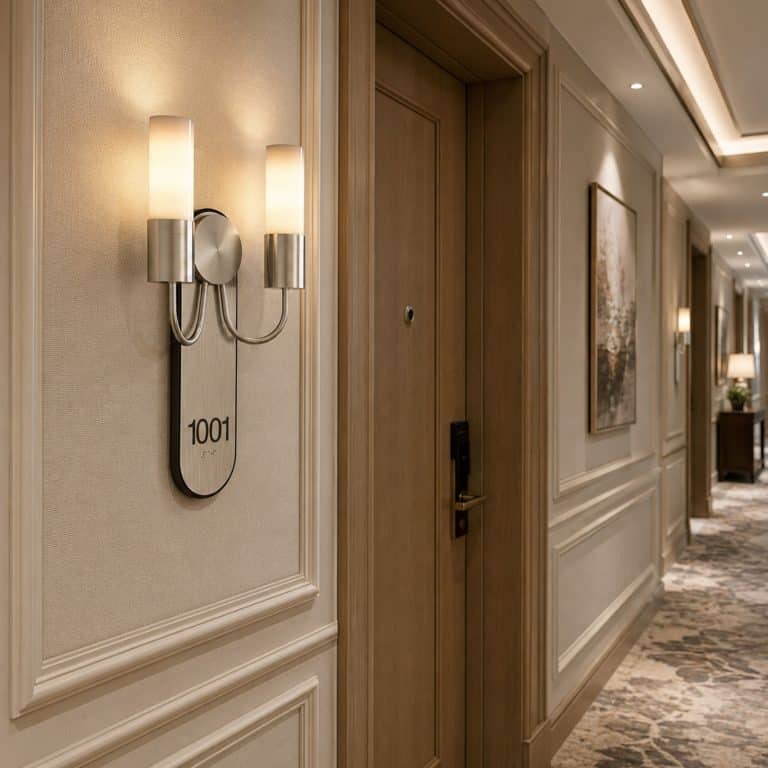
Two lamps can look identical in a showroom and perform very differently after a year in a guest room. One…
Purchasing agents and designers open most guestroom packages with one question: can one lamp carry USB-C charging and a grounded…
A qualified manufacturer can build a light fixture from your sketch or rendering. Custom light fixture fabrication is how a…
Choosing a hospitality lighting manufacturer is one of the first sourcing decisions on a hotel project. The choice shapes your…