Good hotel room lighting does quiet, specific work. It helps a guest find the door, read in bed, get ready at the mirror, and wind down for sleep.
This guide shows how to design guest-room lighting that stays comfortable and durable under commercial use. We cover the functional zones of a room, color temperature and CRI, guest controls, fixture placement, bathroom lighting, energy use, current trends, and common mistakes. As a hospitality lighting manufacturer, we write this for the people who specify and buy: designers, architects, purchasing agents, and contractors.
What Is Hotel Room Lighting Design?
Hotel room lighting design is the practice of planning several small, controllable light sources around how a guest uses the room. It is the opposite of lighting the whole space from one ceiling fixture. Each source has a job, and once it has done that job, it should recede.
This differs from a lobby or restaurant, where fixtures are often meant to be seen. In a guest room, comfort comes first. The fixture itself matters less than the light it puts out.
We also treat hotel room lighting as a specification and manufacturing decision, not only an aesthetic one. The fixtures have to survive years of handling and cleaning. They also have to match across every room and stay on brand.
Why Guest Room Lighting Matters to the Bottom Line
Lighting shapes how a room feels and how well a guest sleeps, and both show up in reviews. Warm, dimmable light in the evening supports a guest’s wind-down routine, while harsh fixed lighting works against it. That link between light and rest is much of why hotel room lighting is worth specifying carefully.
Thoughtful lighting also affects how guests feel. A 2025 Scientific Reports study by Wasti and Chauhan surveyed 100 guests across four coastal beach resorts. It found a positive correlation between sustainable lighting and better guest well-being, though the scope is narrow.
Energy is the other half of the story, and efficient fixtures pay off. A 2019 article in Energies put lighting at a share of electrical energy demand of 15% to 40%, depending on the type of hotel, attributed to 2019 UNWTO data. Total energy use tells a smaller story, and federal lodging energy data shows lighting, cooling, refrigeration, computing, and office equipment each accounted for 10% or less of end-use energy consumption in U.S. lodging buildings (U.S. EIA, 2018 CBECS).
The Five Lighting Zones In A Hotel Room
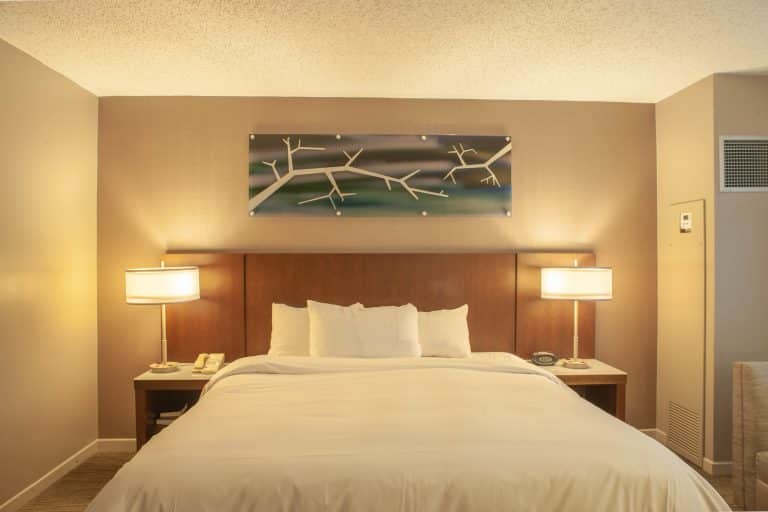
Think of a guest room as a set of lighting zones, each with its own task. A well-designed room usually has at least four independently controllable sources plus a low ambient layer. That lets a guest light only the part of the room they are using.
The table below maps each zone to its task and the fixture consideration that matters most.
| Zone | Lighting Task | Key Fixture Consideration |
|---|---|---|
| Entry / Closet | Safe arrival and packing | A switch by the door and even light inside the closet |
| Bed / Headboard | Reading and bedside control | Glare control at eye level; a switch within reach |
| Desk / Workspace | Focused task light | Cooler, brighter light aimed at the work surface |
| Seating / Reading | A second pool of light | An independent lamp away from the bed |
| Bathroom / Vanity | Grooming and skin tone | Shadow-free vertical light and high color accuracy |
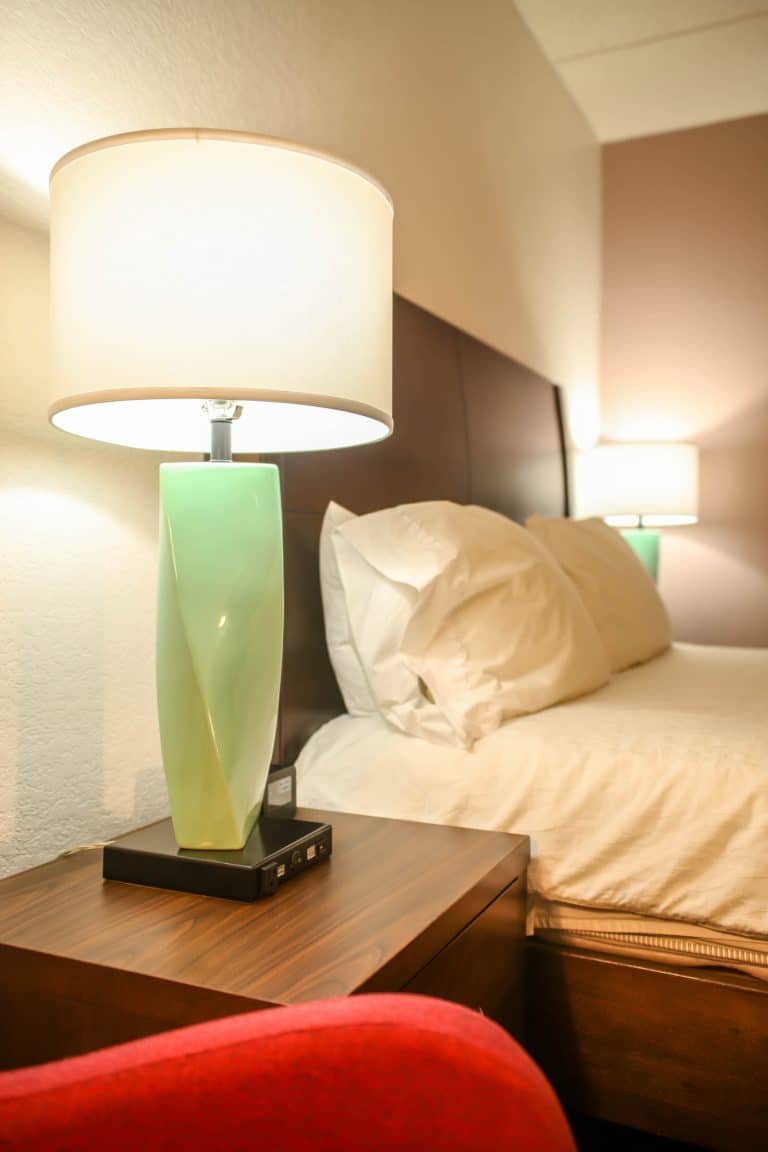
At the bed, contract-grade wall sconces free up nightstand space and put reading light where a guest needs it. For the workspace, hotel desk lamps give business travelers focused task light.
A pair of guest room floor lamps can anchor a seating corner. A low layer of ceiling fixtures keeps the room from ever feeling dim.
Color Temperature And CRI: Getting The Warmth Right
Once the zones are set, each one needs the right warmth. Color temperature describes how warm or cool a light looks, measured in kelvin (K). Lower numbers look warm; higher numbers look cool and blue-white.
For guest rooms, we specify a warm 2700K to 3000K as the baseline, because it feels residential and helps guests relax. Desk and task areas can move up to around 4000K, where cooler light aids focus. A whole room in cool 4000K or higher tends to read clinical.
CRI, the color rendering index, measures how accurately a light shows color on a 0 to 100 scale. It matters most where guests judge themselves in the mirror. We recommend CRI 90 or higher in guest-facing areas, and CRI 95 or higher at the vanity.
| Area | Color Temperature | Target CRI |
|---|---|---|
| Guest room (general) | 2700K to 3000K | 90+ |
| Desk / workspace | ~4000K | 90+ |
| Bathroom / vanity | 2700K to 3000K | 95+ |
Guest Controls: Dimming And Switching
Warm, well-zoned light only works if guests can adjust it. The guiding principle here is simple: guest control overrides designer intent. A beautiful scheme fails if a guest cannot dim the light or turn off a lamp.
Give each zone its own switch, so a guest can light the desk without lighting the bed. Bedside dimming lets someone read while a partner sleeps. A master switch that kills all lights at once is one of the most appreciated details in a room.
Controls should read at a glance, so touch panels work best with universal symbols instead of text-only labels. Whatever the interface, specify it for repeatability. The same panel across hundreds of rooms is easier to service and to train staff on.
Fixture Placement And The 5’7″ Lighting Rule
The 5’7″ lighting rule is a placement guideline. Mount wall fixtures such as sconces at about 5 feet 7 inches (roughly 170 cm) above the finished floor. That height sits near eye level for an average adult, which keeps light useful while reducing glare.
Treat it as a starting point, not a fixed law. At the bed, what matters is that a reclining guest does not stare into a bare lamp. Bedside sources should sit low enough, and be shaded well enough, that light falls on the page.
Ceiling height changes the approach. In a standard room, a low ambient layer keeps things even; under a high ceiling, add a mid-height source so light reaches the guest. The most common placement mistake is a bedside lamp mounted too high or run too bright.
Bathroom And Vanity Lighting
Bathroom lighting lives or dies at the mirror. The goal is vertical, shadow-free light on the face. That means sources beside or around the mirror, not a single downlight overhead that casts shadows under the eyes.
Balance the color temperature with the rest of the room, and push CRI to 95 or higher. A guest then sees accurate skin tone while shaving or applying makeup. Flattering mirror light is much of what makes a bathroom feel considered, and it shapes how a guest rates the room.
Durability And Serviceability
Guest-room fixtures take abuse that home fixtures never see. They get switched thousands of times, wiped down daily with cleaning agents, bumped by luggage, and left on for long stretches. Contract-grade construction and durable materials keep a fixture looking new past its first season.
Finishes carry much of that load. We publish lighting finish options built to hold up under commercial cleaning cycles and heavy handling. A mismatched or corroded finish in one wing is obvious to guests and staff.
Serviceability is the quiet cost saver. Specify fixtures with replaceable shades and standard sockets a maintenance team can swap without pulling the whole unit. A room that stays serviceable for years costs far less over its life than one replaced early.
Energy Efficiency And LED Standards
LEDs are the standard for hospitality because they use less power and last far longer than the lamps they replaced. Pairing quality LEDs with dimming controls cuts consumption further. Dimmed light draws less energy while extending fixture life.
The savings can be large at portfolio scale. In a documented LED retrofit, Travelodge’s program across 388 UK sites “has saved 20.2 GWh or 4,283 tonnes of CO2e.” Net savings top £3 million per year, self-reported by Travelodge and SMS Energy.
Model your own savings with the earlier distinction in mind. Lighting is a modest share of total energy but a bigger share of the electrical load. Frame the return on the electrical side.
Trends In Warm-Dimming And Smart Controls
Warm-dimming builds directly on the LED efficiency covered above. These LEDs shift from around 3000K toward a candle-like 1800K as they dim. They mimic the way old bulbs warmed up when dimmed, so the effect feels natural in the evening.
Smart and tunable controls are the other trend. Guests increasingly expect app or panel control of lighting scenes, and that expectation is filtering into mid-tier properties. By one smart lighting market growth estimate, the global market was valued at USD 15.7 billion in 2024 and is projected to grow at a CAGR of over 19.3% through 2034 (Global Market Insights, an analyst estimate). We build to it without turning every room into a tech showcase.
Daylight still belongs in the plan. Sheer layers and good blackout control let guests choose natural light by day and full darkness at night. Bespoke fixtures tie all of this to a brand’s identity, which is where custom hospitality lighting turns a trend into something ownable.
Common Hotel Room Lighting Mistakes
Most guest room lighting problems come from a short list of repeat offenders. Each has a straightforward fix.
- A single flat 4000K layer reads clinical. Layer warm 2700K to 3000K sources instead.
- Bedside lamps set too high or too bright blind a reclining guest. Lower and shade them.
- Low-CRI bathroom fixtures distort skin tone. Specify CRI 95 or higher at the mirror.
- A single switch for the whole room removes guest control. Give each zone its own dimmer.
- Fixtures picked after the interior is locked force compromises. Bring lighting in early.
That last point is the one competitors underplay. Lighting has real manufacturing lead times and minimum order quantities. Late specification becomes a scheduling problem as much as a design one.
Lighting As A Brand Touchpoint Across The Property
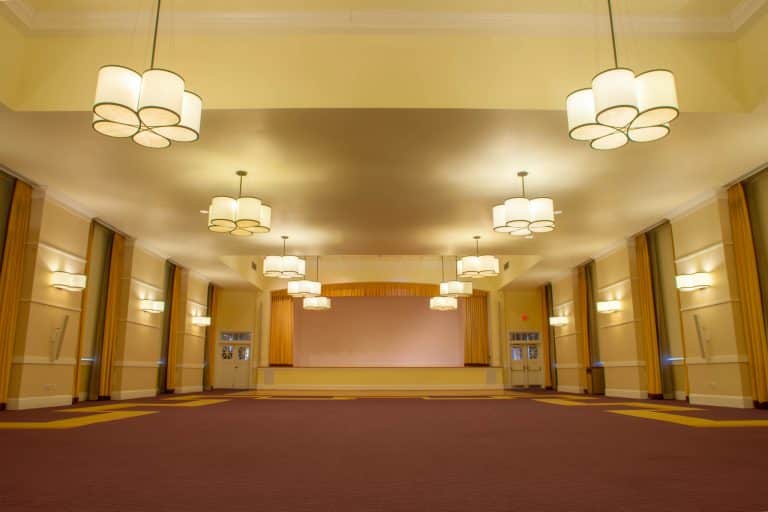
The discipline that fixes those mistakes has to hold across the whole property. Guest-room lighting is part of a path from the entrance through the corridor to the room. The light should feel consistent the whole way.
Consistency gets harder across many properties, which is where brand programs come in. We build hospitality lighting solutions that hold to brand standards from one location to the next. We are an approved vendor for brands including Hilton, Marriott, IHG, Hyatt, Wyndham, and MGM Resorts.
Working With A Lighting Manufacturer Or Light Planner
Holding that consistency across properties takes coordination between a planner and a manufacturer. For anything beyond a simple room, involve a light planner alongside the electrical engineer.
Engineers make sure the wiring is safe and to code. A planner focuses on how the room actually feels for a guest.
Budget for quality where it shows and lasts, and plan around the practical constraints early. Manufacturing lead times and minimum order quantities affect every renovation and new opening. Logistics also have to be coordinated to the install date.
We combine domestic production with long-term manufacturing partners and coordinate schedules to installation timelines. Since 2000 we have completed more than 14,000 hospitality projects from our 100,000-square-foot facility in Roanoke, Virginia. That record includes approved lighting programs for Hyatt House, Hyatt Place, and Garner by IHG.
Frequently Asked Questions
What Color Temperature Is Best For A Hotel Bedroom?
A warm 2700K to 3000K suits guest rooms, while the desk can move toward 4000K. In suites with residential styling, staying at 2700K throughout often reads more premium.
Should Hotel Rooms Have Dimmable Lighting?
Yes. Prefer bedside dimming plus a master off switch, and pick dimming drivers rated for the LED fixtures so low levels stay flicker-free.
What Is The Best Lighting For A Hotel Bathroom Mirror?
Mount light on both sides of the mirror at roughly face height, not only above it. Keep CRI at 95 or higher so skin tone reads true.
How Many Light Sources Should A Hotel Room Have?
Plan at least four controllable sources plus a low ambient layer. Larger suites and accessible rooms often need more, with switches reachable from the bed and the door.
What Is The 5’7″ Lighting Rule?
It mounts wall fixtures such as sconces about 5 feet 7 inches above the floor, near eye level. Drop that height for a low headboard or a seated sightline.
What Is The New Trend In Hotel Lighting?
Warm-dimming LEDs that shift toward candle-like tones as they dim, along with tunable smart controls, are the developments drawing the most attention in hospitality now.
Putting A Hotel Room Lighting Plan Together
Great hotel room lighting is well-zoned and warm, with real guest control and durable construction. Get the color temperature right and place fixtures to avoid glare. Then specify finishes that survive commercial cleaning, and keep the room consistent with the rest of the property.
Those goals are as much about manufacturing and procurement as about design. We have built hospitality lighting since 1922 that holds up across guest rooms, corridors, lobbies, and public spaces at scale. Explore our Custom Capabilities or schedule a consultation today.