Interior Commercial Lighting: What to Check When Comparing Hotel and Residential Lamps
Two lamps can look identical in a showroom and perform very differently after a year in a guest room. One…


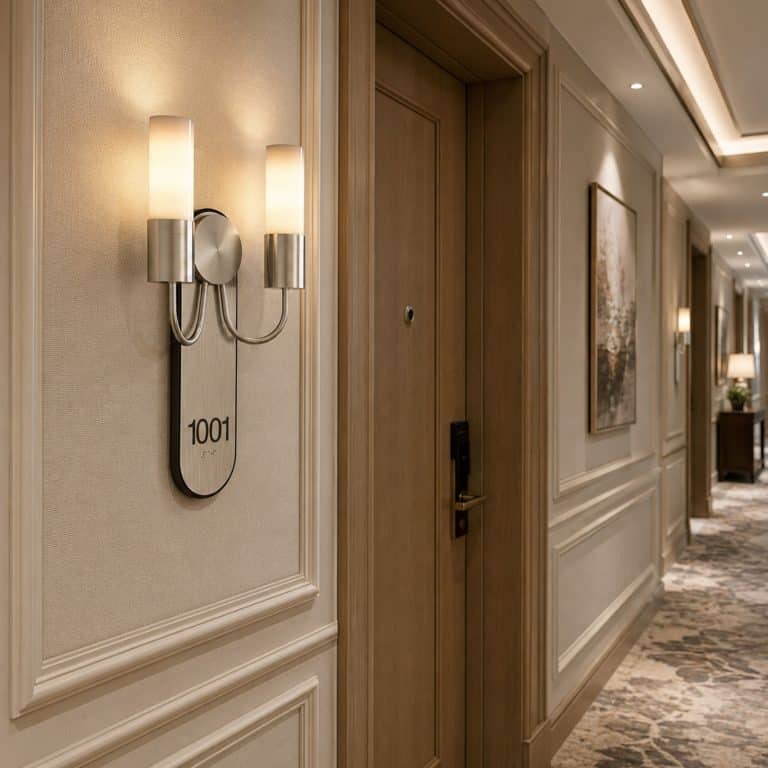
Hospitality lighting covers lamps, ceiling and wall fixtures, illuminated room signs, and lighted mirrors designed and built for commercial hospitality use rather than a private home. “Hospitality-grade” and “contract-grade” aren’t single formal certifications, though. The construction, listing, performance, and documentation a fixture needs depend on what it is and where it’s going, whether that’s a hotel guest room, a senior living corridor, or a multifamily lobby.
The distinction matters because the buyer isn’t a homeowner picking a lamp they like. It’s a designer, purchasing agent, or contractor who has to hit a brand standard, a budget, a lead time, and a durability threshold across dozens or hundreds of rooms at once. That’s the sourcing problem this guide walks through: what a fixture has to meet, where it gets used, and how to choose between domestic, imported, modified, and custom production.
Mario Contract Lighting has worked inside that problem since entering the hospitality lighting sector in 2013, building on a century of manufacturing that started in 1922. This guide reflects what a specifier actually needs to decide, in the order they usually need to decide it.
A single hospitality project typically specifies across several fixture categories at once, not just one. The main ones:
Mario’s lighting product lines are organized around this same breakdown (table lamps, floor lamps, ceiling fixtures, and wall lamps) because that’s how a specifier actually browses and orders, not by decorative style.
There’s no single hospitality-grade certificate to check for. Instead, four factors decide whether a fixture fits a hospitality application: how it holds up to traffic, how efficiently it runs, how comfortable it is to be around, and how consistent it stays across a multi-property portfolio. The specific construction, listing, and documentation required depend on the fixture and where it will be installed.
Hospitality fixtures run far more hours per day than a residential fixture, and they take more physical wear: housekeeping carts brushing a wall sconce, a corridor pendant running 18 hours a day, a lobby chandelier that can’t come down for maintenance without disrupting guests. Why high-traffic performance defines hospitality lighting covers the specific construction and testing factors that separate a fixture built for that duty cycle from one that isn’t.
Lighting is one of the largest electricity end uses in commercial buildings, which is why LED has become the default in new hospitality specification. The U.S. Department of Energy’s SSL Forecast Report projects that LED lighting could deliver up to 569 TWh in annual energy savings by 2035 if program efficiency goals are met, with commercial and industrial buildings, hospitality included, driving the largest share of that gain.
Key point: The DesignLights Consortium’s Qualified Products List verifies output, efficacy, color quality, and lumen maintenance for specific categories of commercial LED products, and utility rebate programs often require it. DLC qualification isn’t relevant to every decorative, portable, or guest-room fixture, so check it when a product falls into a DLC category or the project is pursuing a rebate that requires it.
A fixture can be efficient and durable and still fail a guest room if it’s uncomfortable to sit under. Glare control, dimming range, and color temperature all factor into how a space actually feels to occupy, and visual comfort in hospitality lighting covers glare reduction specifically for hotel spaces.
Color temperature is a project-specific design decision. Warmer tones are common in guest rooms and evening social spaces, but the right choice for a lobby, fitness center, or other public area depends on the brand standard, the design concept, daylight, finishes, and how the space connects to its neighbors. Once it’s set, keeping it consistent across every fixture in the space matters as much as the number itself.
A single property can pick fixtures on aesthetics alone. A multi-property brand can’t: the sconce in a Roanoke property has to match the sconce in a Scottsdale property, down to the finish. Hospitality bathroom lighting standards for multi-property hotels walks through what that consistency actually requires at the fixture level. Mario’s brand-approved lighting programs, including pre-approved schemes for Hyatt House, Hyatt Place, and Garner by IHG, support that consistency for brand standards teams, but they don’t guarantee it on their own or remove every project approval. Each property still goes through its own review, and finish, color, and installation still need to be checked on site.
Every hospitality lighting order follows one of these paths, and the right one is project-dependent, driven by timeline, budget, and how much the space needs to be distinct from anything else. None of them has a fixed cost or lead time; quantity, materials, tooling, availability, and complexity decide the outcome for each order.
| Path | What it is | What shapes cost and lead time | Best for |
|---|---|---|---|
| Quick Ship | Pre-developed collections (e.g., Elements, Encore, Essence, Essentials) built for fast turnaround | Availability and order quantity | Projects on a tight schedule that fit an existing collection |
| Modified | An existing design adjusted in finish, size, or minor detail | Scope of the change, materials, sampling, and approvals | Matching a brand standard with an existing design as the starting point |
| Fully custom | Bespoke design-to-production for a one-off or signature space | Design development, tooling, materials, sampling, and approvals | Flagship properties and spaces meant to stand apart |
Mario Contract Lighting works across all three paths, and the choice is usually made early, once a project’s schedule, quantities, and differentiation needs are clear. Projects that need something outside the standard catalog start through the custom fixture request path.
Two shifts are showing up across current hospitality projects. First, layered and scene-based lighting is replacing flat, uniform brightness in many spaces, with ambient, task, and accent light sources working together instead of one fixture doing everything in a room. Second, tunable-white and warm-dim LED are becoming more common options in guest rooms and treatment spaces, where the same fixture needs to support a bright morning setting and a relaxed evening one. ShawContract’s 2026 hospitality design trends coverage documents both shifts as a move toward lighting that responds to how a space is actually used throughout the day, not just how it looks in a rendering.
Key point: Warm-dim, tunable-white, and scene-based controls are useful options, but they aren’t standard in every hotel. They raise the bar on controls and dimming compatibility, and they have to be built on top of a fixture that already meets the project’s durability, efficiency, and consistency requirements.
For purchasing agents and contractors, sourcing decisions come down to three questions: Who’s building it, how fast can it ship, and what’s the minimum order quantity?
Domestic manufacturing and imported production each have trade-offs, and neither is automatically faster or less expensive. The result for a given order depends on quantity, materials, tooling, component availability, and complexity, along with the shipping, documentation, and listing requirements that come with the fixture and where it’s going.
Mario Contract Lighting uses both: a 100,000-square-foot manufacturing facility in Roanoke, Virginia, and established global manufacturing partners. The choice between them is made for each project based on what it needs, so a project isn’t locked into one path by default.
What is hospitality lighting? Hospitality lighting covers fixtures, illuminated signs, and lighted mirrors built and specified for commercial hospitality properties like hotels rather than for residential use. “Hospitality-grade” isn’t a single certification; requirements depend on the fixture and its application.
What type of lighting is best for a restaurant or hotel dining space? Layered lighting works well: dimmable ambient light for mood, focused task lighting over tables, and accent lighting on architectural or design features.
What’s the difference between modified and fully custom hospitality lighting? Modified lighting adjusts an existing design’s finish or size, while fully custom lighting is built from a bespoke design for a one-off or signature space. Cost and lead time for either depend on quantity, materials, tooling, and complexity.
Do hospitality lighting fixtures need to meet brand standards? For a multi-property hotel brand, yes. Fixtures typically need to match an approved scheme so guest experience stays consistent from property to property. Brand-approved lighting programs support that consistency, but each project still goes through its own approvals.
Is LED required for hospitality lighting projects in 2026? It’s not universally mandated, but LED has become the default choice for new hospitality specification because of its energy efficiency, longer service life, and lower heat output compared to older lighting technology.
Sourcing hospitality lighting comes down to defining the space, confirming what each fixture has to meet for its application, matching the visual comfort a guest needs, and then choosing a sourcing path that fits the project’s quantities, timeline, and budget: Quick Ship, modified, or fully custom, produced domestically or through global partners.
Mario Contract Lighting has worked through that decision path with specifiers since entering the hospitality sector in 2013, building on a family-owned manufacturing history that goes back to 1922. The company is an approved vendor for Hilton, Marriott, IHG, Hyatt, Wyndham, and MGM Resorts, with completed projects visible in its hospitality lighting portfolio. For a project that needs a defined path forward, request a quote to start the conversation.
Recent News & Updates
Two lamps can look identical in a showroom and perform very differently after a year in a guest room. One…
Purchasing agents and designers open most guestroom packages with one question: can one lamp carry USB-C charging and a grounded…
A qualified manufacturer can build a light fixture from your sketch or rendering. Custom light fixture fabrication is how a…
Choosing a hospitality lighting manufacturer is one of the first sourcing decisions on a hotel project. The choice shapes your…