Interior Commercial Lighting: What to Check When Comparing Hotel and Residential Lamps
Two lamps can look identical in a showroom and perform very differently after a year in a guest room. One…


Hospitality lighting fixtures are the individual lamps, ceiling and wall fixtures, illuminated signs, and lighted mirrors that make up a property’s lighting scheme, built for commercial use rather than residential standards. A single hospitality project usually specifies across several of these categories at once. A guest room alone might combine a table lamp, a floor lamp, and a wall sconce.
“Contract-grade” isn’t one universal certification. Whether a fixture suits a hospitality project depends on its construction, stability, mounting, electrical listing, durability, serviceability, and the specific application it’s going into. A nightstand lamp, a corridor sconce, and a vanity fixture next to a shower each have to meet a different set of conditions.
This guide breaks hospitality lighting down by fixture category, the way a specifier actually browses a catalog, and covers the specs that decide whether a fixture is right for the space: suitability for the application, color rendering, and finish.
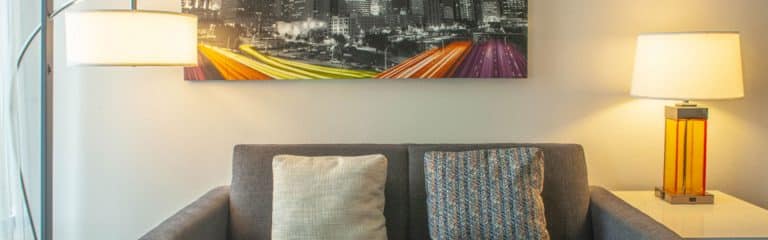
Table and floor lamps carry most of a guest room’s task and ambient lighting. Table lamps cover desk, public-area, and nightstand applications, each sized and positioned for a different task: reading, working, or general room light. Floor lamps fill the same role in guest rooms and lobbies where a table surface isn’t available or a taller light source works better for the layout. For portable lamps, stability matters as much as style. A weighted base and secure shade hardware keep a lamp upright through daily housekeeping.
Ceiling fixtures cover the widest range of any category (chandeliers, pendants, flush mount, semi-flush mount, and track lighting) because they serve everything from a decorative lobby centerpiece to functional corridor illumination. Small pendant lighting by application covers how pendant scale and placement change depending on whether the fixture is doing decorative or functional work.
Key point: A chandelier and a flush mount fixture might both be “ceiling fixtures,” but they’re specified for opposite reasons: one for visual presence, the other for even, unobtrusive coverage.
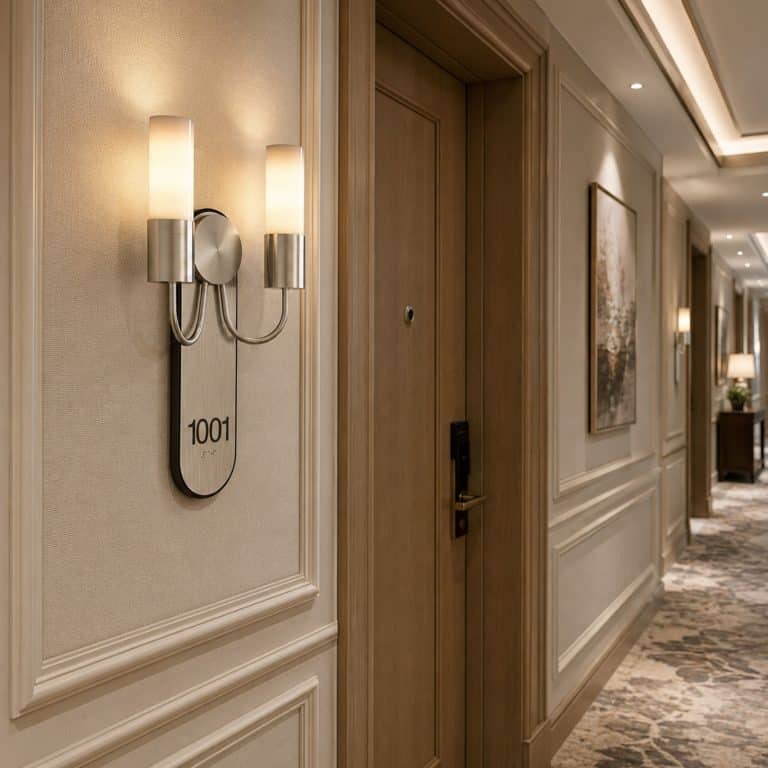
Wall lamps and sconces are specified by exact location as much as by style: corridor sconces, headboard and nightstand wall lamps, and bathroom vanity sconces each have different height, glare, and spacing requirements depending on where they’re mounted.
Only illuminated room signs count as lighting; non-illuminated signs fall under signage and wayfinding. The two are often specified in the same package because they share a design language and a location. Illuminated and wayfinding room signs cover both: illuminated room numbers that need to stay legible in low-light corridors, and non-illuminated wayfinding signs that direct guests through a property.
Lighted mirrors combine two specification problems into one fixture: the mirror itself and the light source built into it. Because the light is built into the mirror frame, it has to deliver even illumination across the whole reflective surface, not just a bright spot near the top.
Rounding out the category are the parts that keep the rest of a hospitality lighting scheme running: replacement shades, commercial LED bulbs, and accessories like luggage racks and fans. These are often simpler to source than a full fixture change, since they replace or supplement fixtures that are already in place, though lead time still depends on availability and quantity.
Start with suitability for the application: construction, stability, mounting, electrical listing for the location, durability, and serviceability. Beyond that, two technical specs come up in almost every hospitality lighting fixture conversation, regardless of category: color rendering and finish.
Color Rendering Index, or CRI, measures how accurately a light source renders color compared to a reference source, on a scale up to 100. A CRI of 90 and an R9 of 50 or higher are useful targets where color accuracy matters most (mirrors, food, artwork, and skin tones), but they aren’t universal hospitality requirements. R9 measures how well a light renders deep reds specifically, which CRI alone can miss even at a passing score.
Key point: A fixture rated CRI 80 can still render skin tones and red fabrics poorly if its R9 value is low. Where color accuracy matters, ask for both numbers, not just the headline CRI figure.
Material choice affects both how a fixture looks and how it holds up under commercial use. Studio Black Canvas’ 2026 hospitality lighting trend coverage notes a shift toward solid metals such as brass and copper, chosen for material authenticity. Finish durability is its own question: powder coating is itself an applied finish, and how well any finish (powder coat, wet paint, or plating) resists chipping and wear depends on the base material, surface preparation, and application quality.
Once a fixture category and spec are settled, the remaining question is how to source it. Quick Ship collections are designed for shorter lead times; a fixture that needs a finish or size change, or a fully custom design, adds development and approval steps. Actual lead time depends on availability, quantity, and the level of customization, so confirm it for each order rather than assuming one path is always faster.
What are hospitality lighting fixtures? Hospitality lighting fixtures are the lamps, ceiling and wall fixtures, illuminated room signs, and lighted mirrors built for commercial use in hotels and similar properties. “Contract-grade” isn’t a single certification; suitability depends on construction, listing, durability, and the application.
Where can I buy hospitality lighting fixtures? From a contract lighting manufacturer, through a lighting distributor, or through a design or procurement representative. Lead time depends on availability, quantity, and customization rather than on the buying channel alone.
What is the latest trend in light fixtures? For 2026 hospitality projects, trends include solid metals such as brass and copper and layered, scene-based lighting rather than a single fixed light level per room.
What CRI should hospitality lighting fixtures have? CRI 90 with an R9 of 50 or higher is a useful target where color accuracy matters (mirrors, food, artwork, and skin tones), but it isn’t a universal requirement for every hospitality fixture.
What’s the difference between a modified and fully custom fixture? A modified fixture takes an existing design and adjusts its finish or size, while a fully custom fixture is built from a bespoke design and isn’t limited to the catalog. Cost and lead time for either depend on quantity, materials, and complexity.
Specifying hospitality lighting fixtures comes down to choosing the right category for the space, confirming the fixture suits the application (construction, listing, durability, serviceability, color rendering, and finish), and picking a sourcing path that fits the project’s timeline.
Mario Contract Lighting produces fixtures across every category in this guide (table lamps, floor lamps, ceiling fixtures, wall lamps, room signs, and lighted mirrors) through its 100,000-square-foot manufacturing facility in Roanoke, Virginia, and established overseas manufacturing partners, building on manufacturing experience that goes back to 1922. See completed hospitality lighting fixture installations in the company’s portfolio, or request a quote to start specifying for a project.
Recent News & Updates
Two lamps can look identical in a showroom and perform very differently after a year in a guest room. One…
Purchasing agents and designers open most guestroom packages with one question: can one lamp carry USB-C charging and a grounded…
A qualified manufacturer can build a light fixture from your sketch or rendering. Custom light fixture fabrication is how a…
Choosing a hospitality lighting manufacturer is one of the first sourcing decisions on a hotel project. The choice shapes your…