Specifying fixtures for a hotel or public space means meeting the Americans with Disabilities Act (ADA). This guide explains what ada compliant lighting is, gives the exact numbers you need for each fixture type, and shows what can be changed on a fixture to hit them. It ends with a checklist you can run before you order.
What Does ADA Compliant Lighting Mean?
ADA compliant lighting is lighting that is designed and mounted so people with disabilities can use a space safely, controls included. The rules cover how far a fixture sticks out and how much clearance it leaves overhead. They also set how easily a person reaches and works its controls.
“ADA compliant” describes an installation in its real context, not a product sitting on a shelf. The same fixture can comply in one location and fail in another, depending on how and where it is mounted. That is why no manufacturer, including us, can label a catalog fixture compliant as shown.
A common myth is that the ADA sets brightness levels. The ADA does not set a minimum light level or foot-candle target. It governs protrusion and clearance instead, plus how a person reaches and operates the controls.
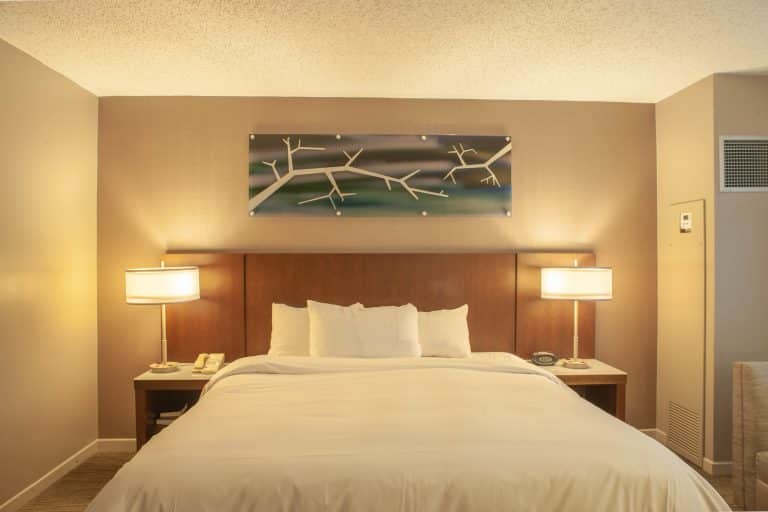
This matters on every floor of a hospitality property. Mario Contract Lighting builds fixtures for the industries we serve, including guest rooms, corridors, lobbies, and restaurants. The same rules apply to each fixture you specify, and our team helps designers meet them alongside brand standards.
Why ADA Lighting Compliance Matters
Accessible lighting affects a large share of your guests. According to CDC disability prevalence data, 28.7% of U.S. adults (70 million) report a functional disability, rising to 43.9% among adults 65 and older.
Good placement protects two groups in particular. A guest using a cane needs to detect a fixture before walking into it. A guest using a wheelchair needs to reach controls from a seated position.
The financial stakes are real too, and they apply to ADA public accommodation violations. The maximum civil penalty, per current ADA civil penalties, is $118,225 for a first violation and $236,451 for a subsequent one, effective July 3, 2025.
Can A Fixture Be Made ADA Compliant?
Usually, yes. A stock fixture that sits outside the compliant zone in one application is often a dimension change away from landing inside it, and most fixtures in our catalog can be modified that way.
The change is almost always dimensional rather than cosmetic. These are the variables that move a fixture into the compliant zone:
- Projection depth: the body of a wall fixture is shallowed so it holds to the 4-inch limit in the restricted zone.
- Mounting position: the leading edge is moved so it falls below 27 inches or above 80 inches instead of inside the restricted band.
- Drop length: a pendant or chandelier is shortened so its lowest point clears 80 inches over a walking path.
- Overall scale: proportions are adjusted so a shallower depth still reads correctly in the room.
- Switch and control selection: on portable lamps, a rocker or paddle switch replaces a small toggle or twist dimmer.
There are two paths to those changes, and they carry different lead time and cost profiles. The choice is settled early in quoting.
| Path | What Changes | When It Fits |
|---|---|---|
| Modified existing design | Depth, size, mounting, drop length, finish | A catalog fixture is close, but the application puts it outside the compliant zone |
| Fully custom one-off | Designed to the space from the start | A signature space, or no existing design is close enough to modify |
One caution: modification gets a fixture into a compliant dimension, but it does not settle compliance on its own. The installed location still decides it, which is why the checklist at the end of this guide runs on the specified installation, not the product.
ADA Requirements For Wall Sconces
Wall sconces are the fixture most often caught by ADA rules. They mount on walls along corridors and other circulation paths, right where a person walks. The standard reads a wall in three vertical zones, based on the height of a fixture’s leading edge.
The lowest zone is the cane sweep zone. The cane sweep detection zone covers leading edges 27 inches high maximum, which can protrude any amount because a cane detects them. That same guide notes an object providing minimum headroom clearance (80 inches minimum) also poses no hazard.
The middle zone is the restricted zone, and it governs most sconces. Under §307.2, ADA protrusion and reach standards limit a fixture with a leading edge 27–80 inches high to a 4-inch projection into a circulation path.
Above 80 inches is the unrestricted zone, where projection is not capped. This table sums up the three zones.
| Vertical Zone | Leading Edge Height | Allowed Projection |
|---|---|---|
| Cane sweep zone | 27 inches and below | Any amount |
| Restricted zone | 27–80 inches | 4 inches maximum |
| Unrestricted zone | 80 inches and above | Any amount |
In a guest-room or corridor sconce, the fixture body usually lands inside the restricted zone. That is why the 4-inch projection limit drives so many sconce decisions.
Depth is also the easiest dimension to change. Our hotel wall sconces are a starting point rather than a compliant product, and the body can be shallowed to hold the 4-inch limit without losing the look a brand standard calls for.
What Is An “ADA Sconce”?
“ADA sconce” is a colloquial label, not a product model. It means a wall sconce dimensioned and mounted so its leading edge meets §307 in its actual location.
Treat the phrase as a description of a specified installation, not a line item you can order. Our vanity sconce guidance shows how the same thinking applies in guest bathrooms.
ADA Requirements For Light Switches And Controls
Switches and controls are operable parts, and their reach range is what matters. The ADA reach range standard at §308 sets where the operable part sits, between 15 inches minimum and 48 inches maximum above the finished floor.
Remember that 48 inches is the maximum height for the operable part, not a fixed mounting height. Do not read the rule as “switches must be at 48 inches.”
Operation rules apply on top of reach. ADA operable parts guidance confirms light switches are operable parts, and all of them are required to comply.
They must be operable with one hand and require no tight grasping. Pinching or twisting of the wrist must not be needed, and the force must stay at 5 pounds maximum. There is no exemption that lets one switch per room skip the rule.
Rocker and paddle switches satisfy the one-hand rule more easily than small toggles or twist dimmers. Confirm the operating force and the reach height together, since a switch can pass one test and fail the other.
ADA Requirements For Table, Reading, And Floor Lamps
Portable lamps are not regulated as manufactured products. The obligation falls on the specifier who places the lamp, so avoid labeling any portable lamp categorically compliant or exempt.
Three things matter when you place one. Any built-in switch or dimmer sits within the 15 to 48 inch reach range and follows the operability rules. The lamp also stays off required circulation paths so it never becomes a protruding object.
Floor lamps need one more check. Keep 60 inches of turning space nearby so a wheelchair user can maneuver, since a base on an open floor can block that space.
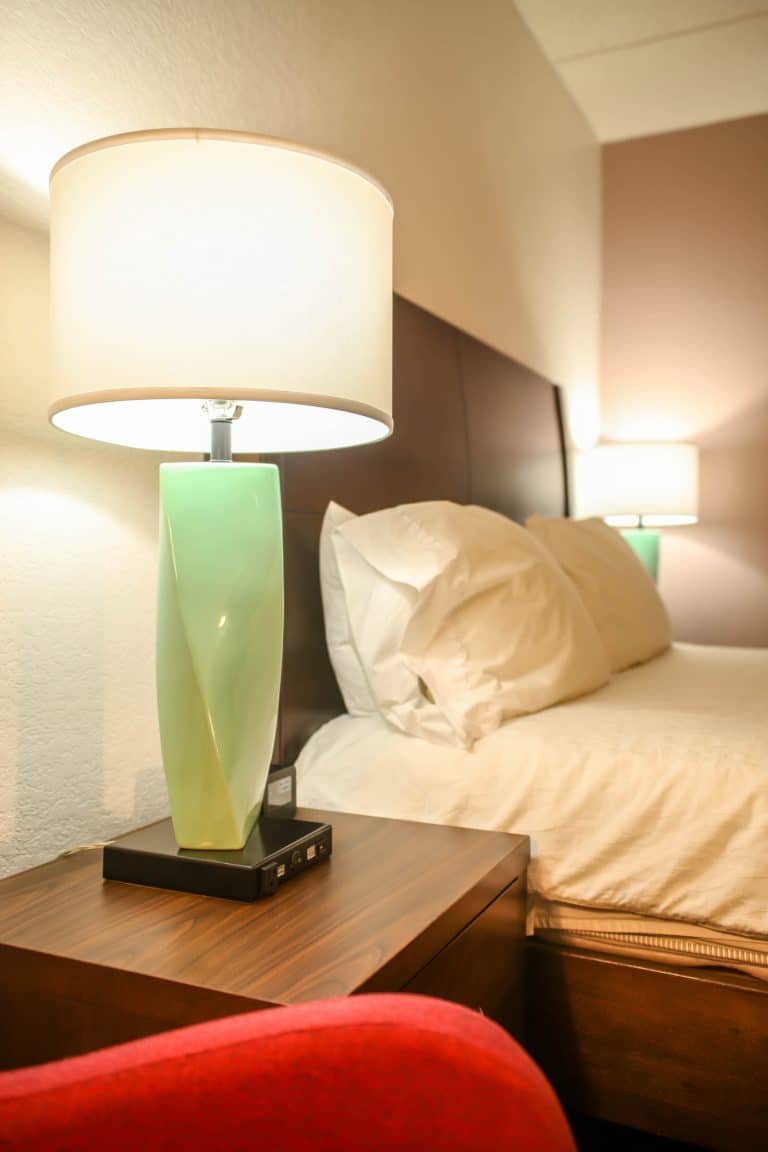
Switch type and base footprint are both specification choices, not fixed features. Our hospitality table lamps and contract floor lamps can be built with a rocker switch or a tighter base where a guest room or lobby placement is constrained.
ADA Requirements For Ceiling Fixtures And Pendants
Ceiling fixtures answer to one main number, the 80-inch vertical clearance rule at §307.4, which requires at least 80 inches of headroom on circulation paths. A fixture whose lowest point stays at or above 80 inches faces little restriction.
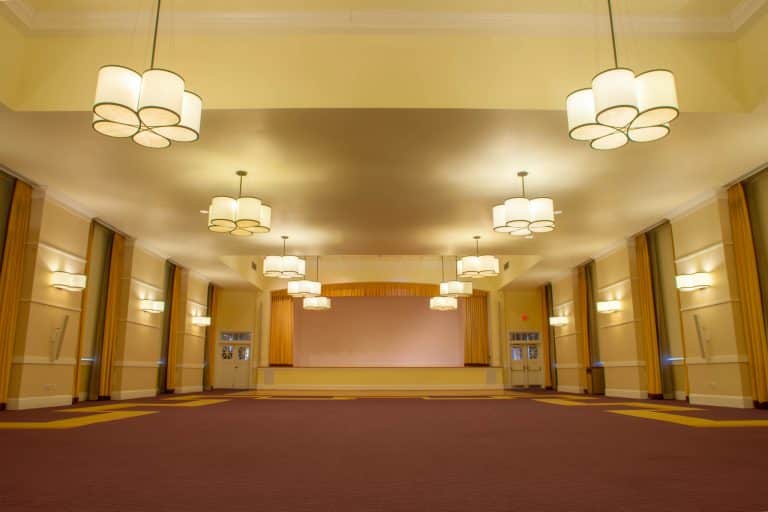
That clearance gives real design freedom overhead. Chandeliers and large pendants can hang in a lobby or ballroom as long as they clear 80 inches over any walking path.
Measure to the lowest point of the fixture, such as the bottom crystal or the finial. A fixture that clears 80 inches at its body can still hang too low at its trim.
The problem starts when a pendant drops below 80 inches on a path, as low decorative pendants sometimes do over a corridor console. A fixture in that position needs a detectable barrier, such as furniture or a rail, so a cane user senses it. Drop length is a build variable, so our hotel ceiling fixtures can be shortened to keep public paths clear.
How To Specify ADA Compliant Lighting: A Checklist
Run each specified fixture through this checklist before you order. It pulls the numbers above into one pass.
- Confirm each wall sconce’s leading edge and projection against the correct zone (4 inches maximum in the 27–80 inch range).
- Place each switch’s operable part between 15 and 48 inches, and confirm one-hand operation at 5 pounds of force maximum.
- Keep portable lamps off required paths, and hold 60 inches of turning space near floor lamps.
- Keep ceiling fixtures at or above 80 inches over circulation paths, or add a detectable barrier where they hang lower.
- Confirm compliance in the real installed location, since dimensions alone do not settle it.
- Flag any fixture that fails one of these checks for modification rather than swapping the design out.
That last point is the one most schedules miss. A fixture that misses by an inch of depth or a few inches of drop is usually a modification, not a redesign, and the look the brand standard approved stays intact. Start a custom lighting request when a stock fixture does not land inside the compliant zone.
What Are The ADA Accessibility Requirements For 2026?
The governing rule for 2026 is the 2010 ADA Standards for Accessible Design, the same standard behind every measurement above. The fixture numbers are unchanged for 2026. The 4-inch projection limit and the 80-inch clearance stay the same, and so does the 15 to 48 inch reach.
Penalty figures are the current values shown earlier and apply through 2026 until the next inflation adjustment. Stricter local codes can add requirements on top of the ADA. California’s Title 24 and New York City’s accessibility rules are two examples worth checking early in a project.
Frequently Asked Questions
Are Mario Contract Lighting’s fixtures ADA compliant?
No fixture is compliant as shown, because compliance depends on where and how it is installed. Most fixtures in our catalog can be modified in depth, mounting, or drop length so they land inside the compliant zone for a given application.
What can be changed on a fixture to meet ADA requirements?
Projection depth, mounting position, drop length, overall scale, and switch type are the usual variables. Most are handled as a modification to an existing design rather than a fully custom build.
What is the maximum a wall sconce can protrude to be ADA compliant?
A sconce with its leading edge between 27 and 80 inches above the floor may protrude 4 inches maximum into a circulation path.
How high can an ADA light switch be mounted?
The operable part must fall between 15 inches minimum and 48 inches maximum above the floor. 48 inches is the ceiling, not a fixed height.
Does the ADA require a minimum light level?
No, the ADA does not set foot-candle or brightness minimums; it governs protrusion and clearance and how a person reaches and operates controls.
Are ceiling fixtures subject to ADA protrusion rules?
A ceiling fixture whose lowest point stays at or above the 80-inch vertical clearance faces little restriction. A lower pendant on a path needs a detectable barrier.
What are the penalties for ADA lighting non-compliance?
For public accommodation violations, the maximum civil penalty is $118,225 for a first violation and $236,451 for a subsequent violation, effective July 3, 2025.
Conclusion
ADA compliant lighting comes down to a few numbers you can specify with confidence. They start with the three sconce zones and the 4-inch projection limit. They also include the 15 to 48 inch reach and the 80-inch overhead clearance.
Compliance depends on where and how each fixture is installed, not on the product alone. That also means a fixture that misses on one of those numbers is usually a modification away from meeting it.
Mario Contract Lighting has manufactured hospitality fixtures since 1922 and completed more than 14,000 projects since 2000. We customize depth, mounting, and drop length on contract-grade fixtures so they meet these rules while holding your brand standards, for guest-room sconces and lobby pendants alike.
Explore our Custom Capabilities or schedule a consultation today.